
A daily power outage from 2pm to 6pm in the middle of a Mumbai summer, in the name of saving energy. This was the childhood of deep-tech firm Atomionics CEO Sahil Tapiawala.
Mr Sahil, 32, said: “I remember experiencing this right before exams, thinking maybe this is normal. But it turned out that this electricity shortage was affecting India more than anywhere else.” This kick-started his interest in resource exploration and led him to find atomic physicist Dr Ravi Kumar and start Atomionics in 2018.
Their company aims to scan the Earth’s subsurface using quantum sensing and artificial intelligence, hopefully enabling more efficient ways to find energy sources.
Mr Sahil was fascinated by Dr Ravi’s work using lasers to cool atoms, making them more sensitive and reliable for measuring things like gravity. Gravity measurements allow for the identification of different minerals under the earth’s surface or in its subsurface.
According to the company’s research, 90 per cent of drills in the mining industry fail, a lot due to inaccurate measurements, leading to repeated drilling. Measuring gravity via quantum sensing allows for extremely precise readings, as the measurements come from an atomic level.
Initially, the focus was on minerals and metals. “Countries want to build data centres and shift manufacturing onshore, so I knew that the demand for these materials in the next three to five years would dramatically increase,” he said. This demand has compounded with current trade conflicts and investments in artificial intelligence.
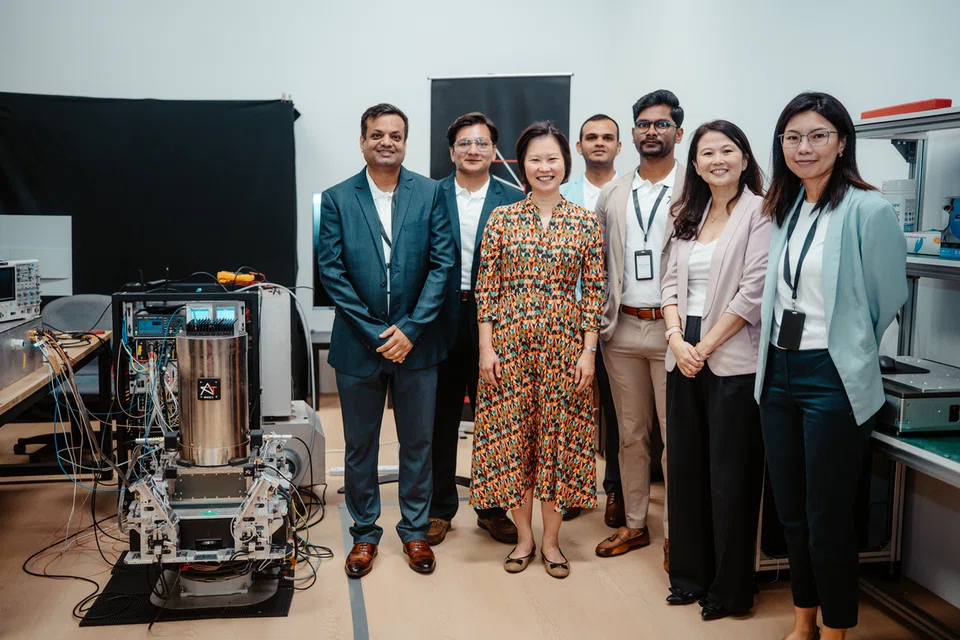
They also took on the challenge of shrinking the hardware down to a size that is convenient to use outside the laboratory. The equipment needed to power the sensors usually fills up an entire room. But after years of trial, Atomionics’ gravimeter, GRAVIO, is the size of a basketball and small enough to be flown around on drones.
To process the data collected by the gravimeters, an “AI Geologist” has been developed called ORE-O. Led by Mr Sean Gerrish, former senior engineering manager at Google and lead engineer behind the creation of YouTube’s ranking algorithm, ORE-O is trained on geological data to crunch readings from GRAVIO. After processing the data, the model creates a three-dimensional map of the scanned surface, marking the locations of the resources identified.
Since then, major investors such as one of OpenAI’s founders, Pam Vagata and the Singapore government via SGInnovate have supported the company, expanding its presence to Australia, the United States, India and where it all began, Singapore.
Energy access
Energy accessibility is one of the company’s main goals; if the sensors can be deployed in countries like India, where resources are abundant but infrastructure is lacking, then there can be a diversification in access to energy. For example, the hour-long power cuts could be deemed unnecessary once there is a consistent source that could be found from the sensors.
Additionally, the sensing would not only save companies up to millions of dollars in blindly drilling, but also reduce unnecessary land destruction, a more sustainable approach.
However, Atomionics’ view of sustainability may not be the standard approach. Mr Anirban Manna, chief of staff, says they are often asked why they operate in the oil and gas space, which is regarded as a polluting energy source, even though their focus is on energy transition and accessibility. “I think people can ask that if they come from a privileged background. In Singapore we can afford to change from coal to solar and wind, but a lot of nations don’t have that luxury as coal is significantly cheaper,” he said.
He adds that the transition needs to be in stages, going from coal to oil and gas. “So, in the aim of getting access to cleaner energy, we can’t leave people behind. There is still a massive percentage of the human population that doesn’t have access to energy,” said Mr Anirban, 29.
Continuing innovation
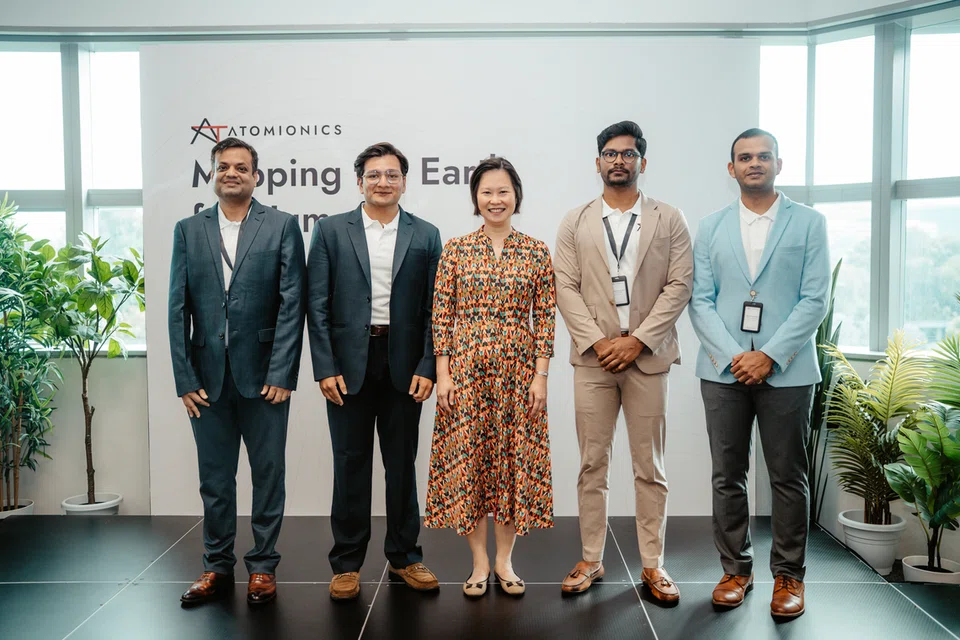
Atomionics opened its new office space in Alexandra Technopark, Asia’s first integrated quantum sensing hub, on July 31.
“The opening of this facility reflects what can be achieved when research excellence, entrepreneurial ambition, and public-private partnership work together,” said Minister of State for Trade and Industry Gan Siow Huang, who was the guest of honour at the event.
“It’s like connecting the dots. Sometimes it takes a while for us to find the dots and link them together, but I’m glad that Atomionics has succeeded thus far in finding the dots and getting them connected.”
She also added that the government will continue investing in deep tech to allow for more companies like Atomionics to develop innovative technologies from Singapore.
Atomionics’ next frontier was also announced at the event, with the greater task of taking its sensors to a new domain.
“I want to begin with something strange. More of the surface of Mars has been mapped in high resolution than the floor of our own oceans. We have better pictures of a planet that is 200km away than of the seabed a few kilometres off the coast. This is not for a lack of trying, but for a lack of a way to see,” said Mr Sahil.
He added that the company is developing its marine intelligence capability. “Singapore will lead the way in our understanding of our oceans,” he said.