
It is not uncommon for a sales director to stride confidently into a boardroom, hand outstretched for a firm handshake. In much of Asia, that approach may miss the mark.
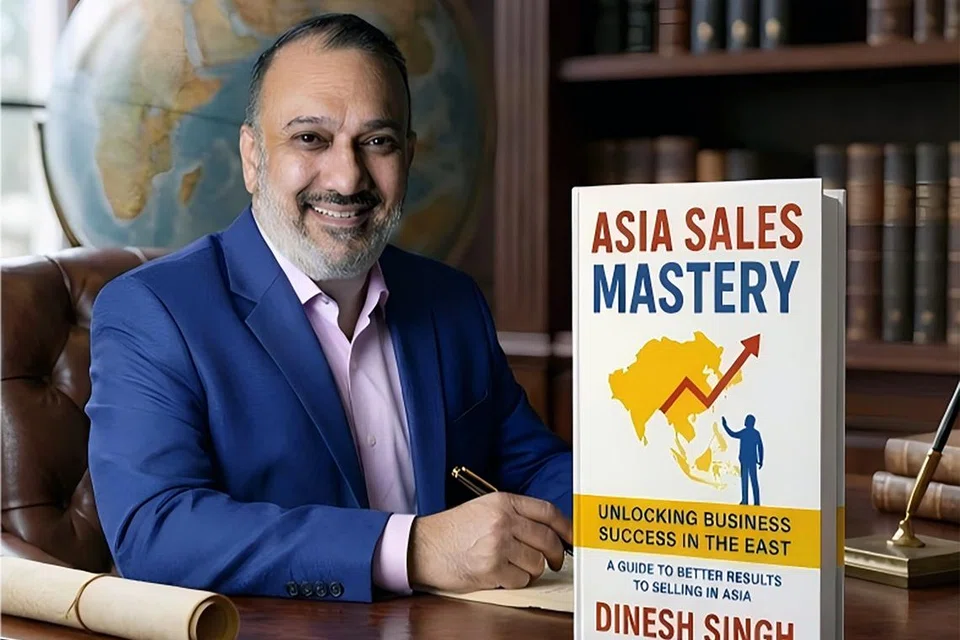
In his book, Asia Sales Mastery, Singaporean author Dinesh Singh, 56, illustrates how something as simple as a greeting can shape first impressions and, ultimately, business outcomes.
“Customs vary from country to country, and understanding these nuances is crucial,” he writes. “Whether it’s bowing in Thailand or offering a polite nod in Vietnam, taking the time to learn local culture speaks volumes about respect and professionalism.”
Blending cultural insight with practical strategy, the book serves as a field guide for navigating Southeast Asia’s diverse business landscape. It outlines key dos and don’ts while offering tailored approaches for markets such as Singapore, Malaysia, Indonesia, Vietnam, Thailand and the Philippines.
For instance, the book highlights that decision-making in markets like Singapore is also strongly driven by data and analytics.
Relationships before results
Western sales approaches often prioritise speed, efficiency and directness. Mr Dinesh argues that these do not always translate well in Asia.
Across the region, personal chemistry comes first. Trust is not assumed; it is earned.
Transactions are rarely one-off deals, but the beginning of long-term partnerships built on mutual benefit.
While the book focuses on Southeast Asia, its lessons extend to larger markets such as India, China and Japan, where cultural expectations similarly shape business interactions.
In China, guanxi, which refers to the intricate web of personal and professional relationships, remains fundamental to conducting business.
There, and in many parts of Asia, even a minor cultural misstep or perceived slight can derail a deal, regardless of how excellent the product or service may be.
Grounded in real-world experience
Mr Dinesh brings more than three decades of regional and international experience to the subject. A graduate of the University of Oregon, where he majored in finance and marketing, he has worked across industries including film distribution, property leasing, brand marketing and product development.
His career includes roles at Samsung SDS’s OpenTide, Fisher Scientific and SuperBrands. At the National University of Singapore Society, he helped generate S$10 million in revenue, including S$1 million in new memberships.
He now serves as vice-president of business development (APAC) at global fintech firm FundCount.
Drawing on this extensive background, Asia Sales Mastery goes beyond textbook theory. Through vivid, real-world narratives – from high-stakes corporate negotiations to on-the-ground customer engagement – it highlights how trust and cultural sensitivity underpin successful sales outcomes.
The book reinforces its argument through a wide range of case studies, from marketing halal food products in Malaysia to delivering renewable energy solutions to Indonesian corporations.
It also draws on practical, ground-level examples, ranging from selling insurance and luxury real estate to Filipino families and promoting agricultural products in rural Vietnam. These demonstrate how sales strategies must be adapted to the local context.
Together, these real-world narratives underscore a central theme: business success in Asia depends less on rigid frameworks and more on cultural understanding and human connection.
“At its core, sales is about people, not just products,” Mr Dinesh writes. “Success comes from understanding those people, respecting cultural nuances and building relationships that last.”
Rethinking Western assumptions
The book has drawn praise. Professor Bruce Blonigen of the University of Oregon calls it “a great resource for sales professionals… to navigate Asian markets effectively”.
Professor Emeritus Larry Ross of Florida Southern College adds that it fills a critical gap: “What is needed is exactly what Dinesh offers – specific insights backed by real-world examples.”
Closer to home, Professor Kulwant Singh of the National University of Singapore Business School notes that the book avoids simplistic answers, instead emphasising the values and actions required for success.
A timely reminder
Asia Sales Mastery, which is available on Amazon, is both a practical guide and a timely reminder that strategies developed in the West cannot simply be transplanted into Asia.
In a region defined by diversity, cultural intelligence is not a “soft skill”. Rather, it is a competitive advantage.
And ultimately, that is what determines business success in Asia.