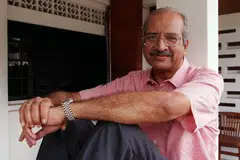
Mr Dhoraisingam Stephen Samuel, a renowned historian who spearheaded efforts to preserve Singapore’s heritage, died on March 14 at the age of 101.
His youngest daughter, Ms Anasuya Dhoraisingam, said he died of age-related pneumonia.
Mr Samuel, who was the former president of the History Association of Singapore and a former deputy director at the Ministry of Education, authored seven significant books on the nation’s history and heritage.
Among them was Singapore’s Heritage: Through Places Of Historical Interest. Written and published in 1991, it remains a key compilation of 180 important sites in Singapore. His 2005 book, Peranakan Indians of Singapore and Melaka, is another notable chronicle of the Chetti Melaka community.
Mr Samuel played a significant role in the formation of the Association of Chetti Melaka, which was established in 2008.
Through his research on the community, Mr Samuel shed light on an important part of Singapore’s early heritage and strengthened the cultural bridge between the Chetti Melaka communities of Singapore and Malaysia, said Mr K. Kesavapany, a former ambassador and ex-director of the Institute of South-east Asian Studies.
Singapore’s late former president S.R. Nathan was the first to bring the unpublished manuscript of the book on the Chetti Melaka community to Mr Kesavapany’s attention.
“I took it home and read it through the night. Following its publication, the community suddenly found its own identity and came together. This is one of Mr Samuel’s greatest achievements,” Mr Kesavapany noted.
Born in 1925 in Kuala Selangor, Malaya, Mr Samuel was one of 11 children. He began his career as an educator, teaching at Victoria School in Singapore in the 1950s, and was known for his fierce advocacy for his students.
Ms Anasuya, a finance professional who majored in history at the School of Oriental and African Studies in London, noted that his zeal for education was inherited.
“My grandfather, Reverend L.A. Samuel, was a Methodist pastor and principal who managed and taught in a school for Indian rubber tappers on the estates,” she said. “I think that was the early root of why my father was very passionate about education.”
Ms Anasuya recalled how former students, now in their 70s and 80s, would approach her father to express their gratitude, saying that he had personally intervened with the principal to save them from expulsion.
Having been active in the Inter-Religious Organisation (IRO), Mr Samuel served as a pillar of Singapore’s racial and religious harmony, noted Mr Ameerali Abdeali, president of the Muslim Kidney Action Association and council member of the IRO.
“I had known Mr Samuel for several decades,” said Mr Ameerali. “I originally invited him to give a talk on the history of Singapore to my charity at the time, the Islamic Fellowship Association.”
“Everyone was fascinated by his knowledge. He was a very humble, gentle man who was obliging and very happy to share his knowledge,” he said.
“Mr Samuel, who documented Singapore’s culture through his research, selflessly expanded the wealth of knowledge that serves as the necessary foundation for harmony.”
Ms Anasuya, who was a former journalist at The Straits Times, recalled that the news desk always sought her father’s views.
“They knew they could always count on my father for a strong, reliable historical perspective,” she noted.
“If you go to the National Archives of Singapore, there are almost 18 episodes of my father discussing the history of Singapore in both English and Tamil. Because he lived to such a ripe old age with a remarkably sharp memory, he became the go-to person whenever someone needed a comment about Singapore’s early history”.
Special research adviser at the Institute of Policy Studies, Mr Arun Mahizhnan, who was a former student of Mr Samuel at Bartley Secondary School, described him as a “deeply inspiring figure to others”.
Mr Arun said that Mr Samuel had worked closely alongside former deputy prime minister Goh Keng Swee on various initiatives, noting that “Dr Goh was not easy to impress”.
Mr Samuel was a vocal advocate for Tamil-related efforts, and played a pivotal role in introducing the Tamil language subject at the then Teachers’ Training College, Mr Arun recalled.
“I had the privilege of writing and reading the citation about Mr Samuel on the local Tamil radio station. We remained in touch for many years, even after he retired. His passing is a massive loss both on a personal and a national level,” he added.
Mr Samuel is survived by three daughters and a grandson.