Long before Orchard Road became Singapore’s retail hub, High Street was the premier shopping district.
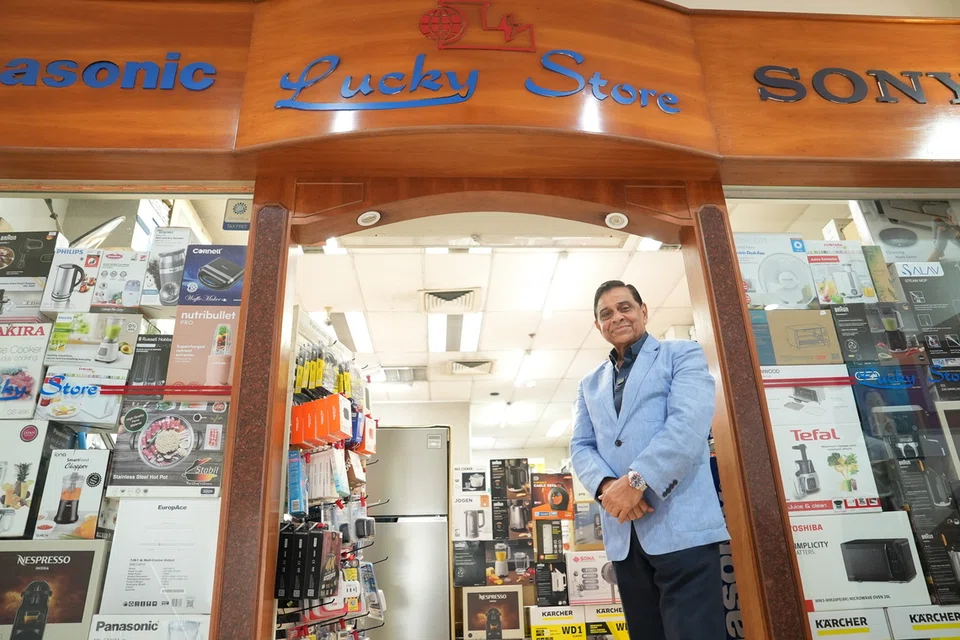
Anchored at High Street Centre from the early 1980s, Lucky Store is one of the pioneers of the city-state’s early retail scene. But even as that scene transformed with the rise of bigger mall chains and e-commerce, Lucky Store has sustained its legacy – thanks to Mr Harry Gurnani, who coyly admits to being in his early 70s.
The jovial but down-to-earth Mr Harry – who is CEO and Director – managed to transform the Lucky Store he inherited from his father, even as he took on other responsibilities in community leadership. And he is looking forward to managing other challenges in his quest to maintain the business enterprise’s legacy.
“Lucky Store is 79 years old. We want it to reach 100 years,” he said. Lucky Store was founded by his father Mr Manghanmal Gurnani.
Originally from Sindh in what is now Pakistan, Mr Manghanmal came to Singapore after the partition of India and Pakistan to work as an accountant in his uncle’s textile business on North Bridge Road before branching out on his own in 1948.
Early on, Lucky Store operated on Transit Road outside Nee Soon Camp, with fishing equipment selling well. Putting an obvious assumption to rest, Mr Harry explained: “The name was not chosen through a horoscope or priest. My father chose the name because customers who bought from the shop should feel lucky.”
Move to High Street Centre and Transformation
Lucky Store moved into High Street Centre in the early 1980s and came under Mr Harry’s stewardship in the late 1980s.
Along the way, it transformed from a camera and audio hub into an authorised dealer for major electronics giants such as National (which later became Panasonic), Sony, Canon, Samsung, and Philips. It also became a registered supplier for statutory boards, military camps, educational institutions, and corporate clients.
In the process, Lucky Store transitioned away from fickle retail foot traffic to high-volume institutional accounts.
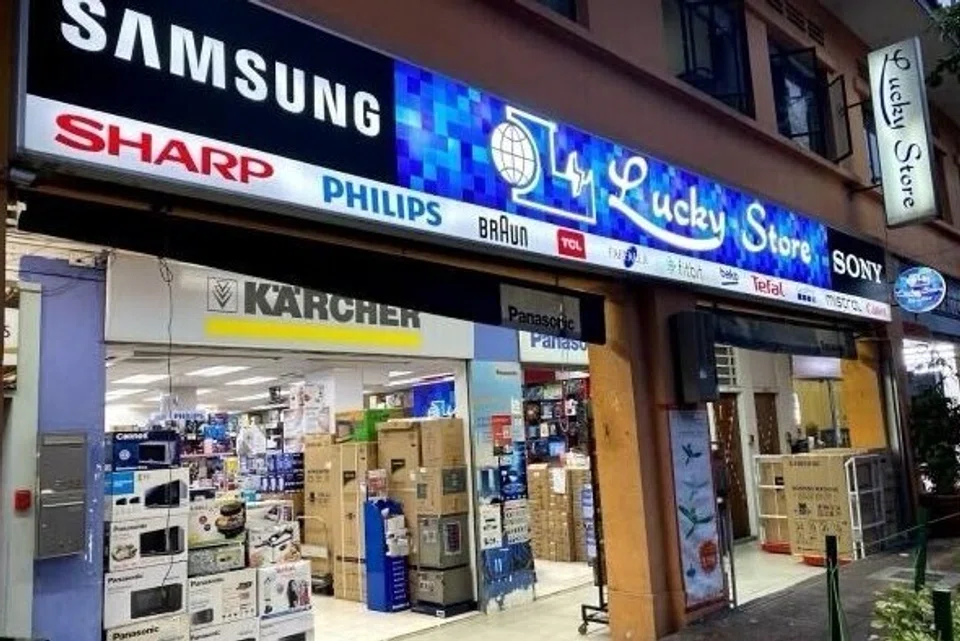
Another strategy was to expand into the suburban space. The large street-facing Tanjong Katong outlet comprising two units was opened in 2014 to serve the affluent East Coast neighbourhood with a mix of local and expat residents. Among the products it offered were large domestic appliances (such as refrigerators and washing machines), cameras, and consumer tech.
Mr Harry manages Lucky Store’s expanded footprint with his brother and son, which doesn’t dilute the family structure. The arrangement allows localised customer-centric oversight of the large Tanjong Katong branch while he focuses more on tenders to supply higher value products to state bodies and on the High Street Centre business.
Despite a challenging market, the sound strategy has helped to almost double annual revenue in a decade. Staffing has grown as well. From two or three staff in the 1970s and 1980s, staff strength grew to six to eight in the 1990s. Lucky Store currently employs 21 staff.
Business philosophy and doctorate
Mr Harry attributes his business acumen to his father, and his approach is to control costs.
“I learned the business from my father, no one else. My father’s rule is not to spend even one dollar unnecessarily. But if the spending is justified, even if it’s S$1,000, it must be spent,” he said.
And from experience, he learnt about the risks in selling on credit.
Mr Harry explained that bad debts were a significant issue for the business from the 1980s through to the 2000. During that period, the company did import and export business, which involved opening letters of credit and extending credit to customers.
Having stopped selling on credit from 2010, he explained: “I would rather sell cheaply if customers pay upfront than extend credit or rely on a guarantor. The reason is simple – I prefer to sleep peacefully and avoid the risk of unpaid debts.”
In recognition of his business leadership and contributions to society, Mr Harry was recently conferred an Honorary Doctorate in Business Administration by the European Institute of Management and Technology.
The doctorate, he believes, has also helped his business standing and adds that it signals to customers that they are dealing with a serious person.
Where Next and Community Engagement
Although the area may no longer be as busy as it once was, Mr Harry is happy in the current High Street location.
He may, however, have to move if High Street Centre’s collective sale is revived but is unfazed by the possibility. “Lucky Store can still operate out from Tanjong Katong and the collective sale may provide a windfall,” he explained.
Two years back in 2024, the collective sale of High Street Centre for S$678 million fell through for a number of reasons. The 30-storey mixed-use development houses about 430 strata-titled units, including offices, retail units and residential apartments.
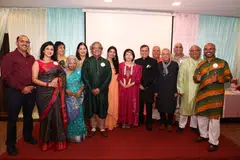
Beyond business, Dr Harry actively contributes to Singapore’s multicultural community. He was recently appointed to the Racial and Religious Harmony Circle under the Ministry Of Culture, Community and Youth (MCCY), serves on the Board of the Hindi Society Singapore, and is the immediate past president of the Singapore Sindhi Association (SSA).
He has been particularly active in SSA from 2010 to 2026. He helped to organise the society’s 100th anniversary in 2022 with then-Prime Minister and current Senior Minister Mr Lee Hsien Loong as the guest of honour.