

Right before starting medical school, Aparna Giri Shankar, 23, was flipping through her childhood notebooks when she came across a page of jumbled, juvenile handwriting.
It was hers, from when she was much younger – and at the bottom of the page sat a pact she had made with her future self, drawn from a line she encountered in the late Dr APJ Abdul Kalam’s book Ignited Minds, in a chapter on pathology.
She made a pact to be someone who “reduced the pain of patients, while researching how the body works”, even though the mere definition of ‘pathology’ was a stranger to her then.
“It’s a very big word, but innately I just felt drawn to it,” she noted.
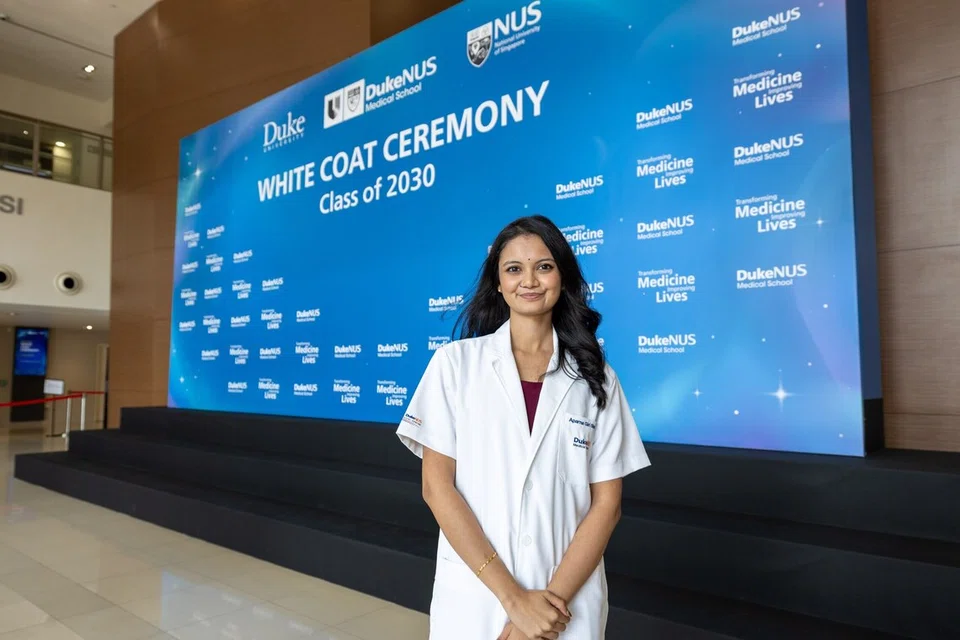
In a prophetic moment, Ms Aparna joined 77 other aspiring doctors at Duke-NUS Medical School’s white coat ceremony on Aug 14, donning the garb that officially commenced her journey towards becoming a physician.
It is the school’s largest intake of women into its medicine programme, with 49 female students, 38 of whom were making a mid-career shift to medicine.
Ms Aparna herself hails from the public health domain, studying public data and concerning herself with numbers that quantify large groups of people, rather than the people themselves.
“They might be very big numbers, but each number represents an individual, and each individual has their own family and their own situations,” she said.
That sentiment brought her to this stage of her life, where pathology became the next logical step and a return to her younger self.
Upon graduation last year, she joined the National Healthcare Group’s Population Health Office, analysing disease prevalence, frailty, and treatment outcomes, building on research she had started as an undergraduate.
“We were exploring dietary antioxidants and dengue viral pathways. These were my active involvements, but naturally I was also curious about understanding and translating these into a macroscopic level, such as outcomes at the population level, which geared me towards taking public health as my second major,” she told tabla!.
However, as enticing as it was to find a new drug or understand the mechanisms of a disease, Ms Aparna felt like she was missing out on the aspect of applying these to the human body.
She noted her family’s unflappable support in arriving at this juncture.
Her older brother, a data analyst eight years her senior, has been a steadying force, and the one she turns to when she doubts her abilities or choices. Her parents grasped the weight a medical career would demand of them before she did.
“Undertaking such a huge journey is not an individual undertaking. It’s a shared commitment, compromise, sacrifice that we have to make as a family as well,” she shared.
Outside the classroom, she is a Carnatic music practitioner, which she has studied since the young age of four, past the point of obligation.
It has become an avenue for her to “self-introspect,” she said, as an art form that, while built on discipline, leaves room for improvisation and finding one’s own way through a raga once the fundamentals are set.
She sees how it parallels medicine – both as forms of communication, conveying comfort or clarity to someone who needs to receive it. She hopes she never has to choose between the two.
As for the kind of doctor she wants to become, Ms Aparna is still keeping her options open on specialisation. But she has a clear measure of what she hopes to achieve.
“If I’m able to impact my patients in even a small manner, that makes a part of their healthcare journey better, that is a big win for me,” she said.