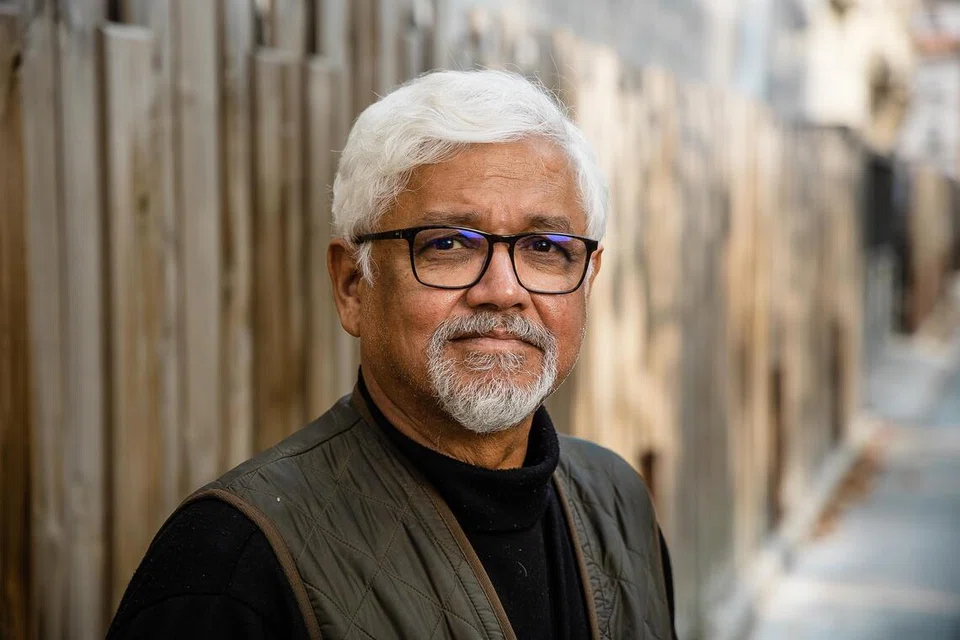


Why are some of the world’s richest and most powerful people building doomsday bunkers instead of investing in saving the planet?
That provocative question will take centre stage when acclaimed Indian author Amitav Ghosh returns to Singapore as a headline speaker at the Singapore Writers Festival (SWF) 2026, running from Nov 13 to 22.
The Jnanpith Award-winning (India’s oldest and highest literary honour), Booker Prize-nominated writer will deliver the festival keynote, A Writer’s Reimagining of Our Planetary Future, at Victoria Theatre on Nov 14 at 1.30pm.
Drawing on his 2025 essay collection Wild Fictions and latest novel Ghost-Eye, Amitav will examine climate change, ecological grief and the increasingly uncertain future confronting humanity, particularly countries in the Global South.
Speaking to tabla!, the 70-year-old author said the festival’s theme, Hidden in Plain Sight, was especially relevant to contemporary global politics.
“In recent years it has become clear that there is a great difference between what global elites say and what they do,” he said.
“Therefore it has become very important to try and understand what their real intentions are, and what it is that is unsaid.”
Amitav has long argued that the climate crisis cannot be understood solely through science and technology. Its roots, he believes, extend into history, politics, colonialism and humanity’s relationship with nature.
However, he cautioned against assuming that poorer countries would necessarily suffer more than wealthy ones.
“Today, Europe is heating at twice the rate of the rest of the planet, and the consequences have been devastating for many parts of the continent despite (or perhaps because of) their relative affluence,” he said.
Singapore, meanwhile, has impressed him with its preparations for an increasingly unpredictable climate.
“Over the years I have been very struck by how cognizant Singapore’s leadership is of the planetary crisis, and how much planning has gone into their preparations for the future,” he said.
“I think these factors will contribute greatly to Singapore’s resilience as the crisis intensifies.”
A new novel, an old warning
Amitav’s Singapore appearance also comes following the publication of Ghost-Eye, his first novel in seven years.
Blending reincarnation, food, memory and climate activism, the novel explores environmental destruction through an imaginative and spiritual lens.
It also revisits characters from his earlier novel Gun Island.
“My approach in this novel is not really very different from that of Gun Island,” he explained. “Essentially both books enframe the planetary crisis not just as a matter of environment and technology but also as an imaginative and spiritual crisis.”
Food occupies a particularly important place in the narrative, connecting personal memories with humanity’s dependence on nature.
“Food is the primary medium through which human beings relate to their environments,” Amitav said. “Paying attention to food is of crucial importance at this time because industrial agriculture has exposed our food systems to many kinds of threats.”
He also believes indigenous communities possess environmental knowledge that modern societies have frequently dismissed or suppressed.
“Only now, when it is already too late in many cases, has that come to be recognised that indigenous people often had a deep understanding of the environments in which they lived,” he said.
Family secrets and inherited silences
Beyond his keynote, Amitav will join Singaporean novelists Jemimah Wei and Balli Kaur Jaswal for What the Family Doesn’t Say, a discussion exploring migration, family secrets and generational trauma.
“In Asia, even more than elsewhere, generational trauma is often a taboo subject,” he observed. “Those who lived through the partition of the sub-continent often resisted talking about it. Only much later did the stories begin to emerge.”
Born in Kolkata and raised across India, Bangladesh and Sri Lanka, Amitav is internationally celebrated for novels including The Shadow Lines, The Glass Palace, The Hungry Tide and the Ibis Trilogy.
His works have been translated into more than 30 languages. In 2018, he became the first English-language writer to receive India’s prestigious Jnanpith Award.
Despite decades of examining environmental destruction, Amitav remains cautious about humanity’s prospects.
“I don’t think anyone who keeps up with the news regarding the planetary crisis can be naively optimistic,” he said.
His message to younger readers in Singapore and across Asia is particularly pointed.
“Highly unequal and deeply divided societies will not be sustainable in the long run.”
And, while literature alone cannot solve the crisis, Amitav believes storytelling remains an essential starting point.
“Of course, storytelling is not enough on its own,” he said. “But I am a storyteller, so that is where I have to begin.”
santosh@sph.com.sg