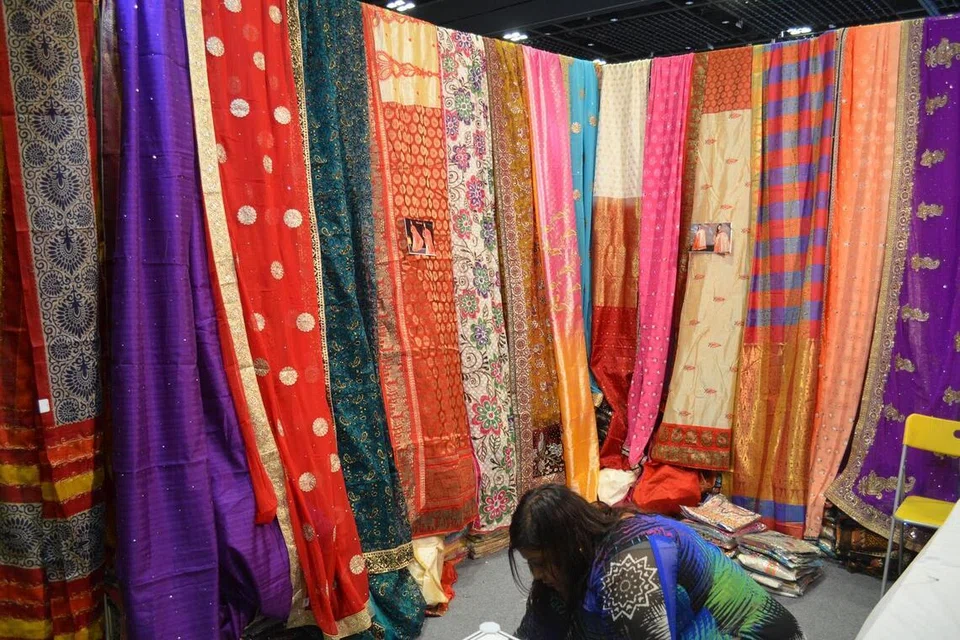

It was a busy Sunday afternoon in Little India. The streets buzzed with colour and noise – the scent of fresh flowers mingling with street food, and shoppers banging into each other at every corner. Amid this vibrant scene, two women found themselves in a small, unassuming sari shop.
Inside, the shop walls were lined with saris of every colour. But it was the one on the mannequin in the centre of the shop that caught the eyes of both Jigna Patel and Priya Ramesh.
Round 1: The sizing-up
Jigna, a Gujarati visiting from Ahmedabad, eyed the emerald green sari with intricate gold zari work. It was the kind of sari that would turn heads and just like one she had seen Deepika Padukone donning.
Priya, a Tamil Singaporean, had also locked onto the same sari. She imagined herself draped in its luxurious fabric at her cousin’s wedding next month. But, she noticed the gleam in Jigna’s eyes and knew this wasn’t going to be an easy purchase.
The two exchanged polite smiles.
“Such a beautiful piece, isn’t it?” Priya remarked, testing the waters.
“Yes, quite stunning,” Jigna replied, her tone pleasant but determined. “You have good taste.”
“You too,” Priya responded with a tight-lipped smile.
The shopkeeper, sensing trouble, hurried over. “Ah, madams, you both have excellent taste! This sari is indeed special – only one piece left in stock. Perfect for a wedding or special occasion.”
The mention of it being the last piece made both women’s eyes narrow ever so slightly. This was no longer just about buying a sari; it was about not letting the other win.
Round 2: The opening bid
Jigna, with the assertiveness of a seasoned Gujarati bargainer, made her move. “How much for this sari, bhaiya?”
The shopkeeper smiled. “For this masterpiece, madam, $600.”
Priya almost choked but quickly recovered. “$600? For this? Come on, uncle, you can do better.”
Jigna, unfazed, gave the shopkeeper a knowing look. “$600 is way too much. I’ll give you $300.”
Priya jumped in. “$300? I’ll give you $325,” she said, not about to lose.
Jigna turned to Priya, her eyebrows raised. “$325? I’m willing to go up to $350, but that’s it.”
Priya shot back, “$375, final offer.”
The shopkeeper, following the back-and-forth like a tennis match, decided to interject. “Madams, let’s settle on $450, and it’s yours.”
Round 3: The tug-of-war
Both women shook their heads simultaneously. Neither wanted to let go. The shopkeeper’s suggestion of $450 was met with silence as they considered their next move.
Jigna leaned in, lowering her voice as if to share a secret. “Bhaiya, I’m Gujarati, you know, like the Ambanis. Just like Nita Bhabhi, we know our saris, and I can tell you right now, this one is worth $400 at most. I’ll give you $400 and not a cent more.”
Priya, not to be outdone, leaned in from the other side. “Uncle, I’ve been shopping here for years. You can’t let a loyal customer walk away empty-handed. $425, and I’ll make sure to tell all my friends to come here.”
The situation was at an impasse.
Suddenly, Priya had an idea. She turned to Jigna and in a hushed tone said: “How about this? You and I both love this sari, but neither of us wants to pay more. So, why don’t we split the cost? We’ll each pay $206, and share the sari.”
Jigna looked at Priya, surprised. It was unconventional, but it made sense. Plus, it meant neither of them had to concede entirely.
The shopkeeper who was only interested in getting his money regardless of who paid, brightened at this proposal. “That’s a fair solution. $412, split between the two of you!”
Priya grinned. “And we can take turns wearing it. I’ll wear it to my cousin’s wedding next month, and then Jigna can have it for her son’s wedding. It’s too beautiful to wear just once! And my guests will be totally different from yours!”
Jigna pursed her lips. She had never done this before. She thought to herself: “Anyway I can’t wear this sari more than once, not after my pictures are shown on Insta and FB. And for the savings of $206, I can pick up matching jewellery too.”
“Deal! And I’ll cover the cost of dry-cleaning after each wear,” Jigna replied out loud.
Both women laughed, pleased with their clever solution. The shopkeeper, relieved to have made the sale, quickly wrapped up the sari and handed it to them.
Aftermath: The bond of sharing
As they left the shop, each with half the victory and a new friend, they walked side by side, laughing and chatting.
“You know,” Priya said, glancing at Jigna, “haggling isn’t just about saving money. It’s about finding creative solutions – and sometimes, making a new friend.”
Jigna nodded. “Exactly. And the best part? We both feel like we’ve won. That’s the true art of haggling.”
Haggling, as Jigna and Priya’s story shows, is more than just a way to save money. It’s a social ritual, a cultural practice honed over centuries. In markets across India and in Indian communities around the world, haggling is a way to connect with others, assert one’s knowledge and find satisfaction in the process. It’s about relationships, stories, and memories.
Whether you’re kanjoos (stingy) or savvy, haggling is a part of who you are, and a tradition that adds excitement to shopping and leaves everyone with a story to tell.
So the next time you’re in Little India or any other market, don’t be afraid to haggle. Embrace it, enjoy it and remember: It’s not just about the price – it’s about the experience, the connection and the joy of the game.