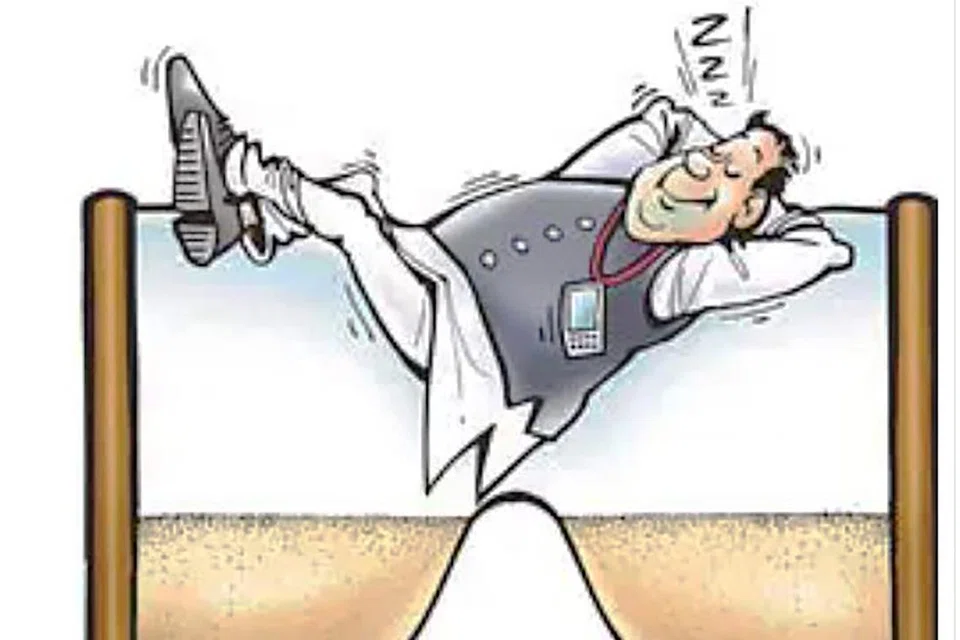
For Indians, time is a loose concept, akin to a bathrobe worn to relax at the poolside. In India when we say we will do something “by tomorrow”, we mean we’ll get to it in the next 10 to 15 days, God willing.
Likewise, if we observed the full moon “just yesterday”, we may have seen it during the last week (and perhaps it had not been really, completely full). And on both occasions, we’d say “kal”, an accommodating Hindi word meaning both tomorrow and yesterday.
But, for Singaporeans, time is not a loose bathrobe; it’s a skin-tight Spandex bathing suit.
As a newbie here, I learnt this the hard way. Singtel’s help desk told me that a technician would come home the next day between 11am and 1pm and would phone me when nearby.
My phone rang at 10.15am the next day. “From Singtel,” the man said crisply. “I’m nearby. Can I come now?”
“Oh my God!” I cried. “I’m not at home now.” He said: “No problem, I’ll come at 11 am.”
“I’m so sorry,” I said. “I had to travel to Malaysia on urgent work.” (I was in Melaka with my family for sightseeing but thought it prudent to sacrifice honesty at the altar of diplomacy.)
The man kindly agreed to come the following day, and did, landing up before the appointed time.
In contrast, when you explain your problem to the plumber or electrician in India, they will invariably say: “Kal aa jaayenge” (will come tomorrow).
You can reasonably travel to a neighbouring city for sightseeing the next day; in fact you could even squeeze in a neighbouring country.
Because their “kal” means you need to call them in a week to remind them; then again a day or two after that. Finally, in the fullness of time, they will arrive.
Meanwhile something else at home would’ve conked off, and you can get two jobs done through one appointment.
You encounter the same tendency of promising the moon but delivering a half-baked pancake on the road.
Once I had only 20 minutes to make it for an appointment in India. Waiting anxiously at a traffic signal, I asked the taxi driver how much longer. He promised to drop me off in “five minutes”.
I felt reassured, but, when I found myself stuck at the same signal five minutes later, not so much. So I asked the question again.
“Five minutes,” he said again and added, with quiet confidence: “Just let this signal turn green.”
Like this, a painful “five minutes” at a time, I was dropped off 45 minutes later. (The person I was meeting rendered me early by arriving even later.)
In my early days in Singapore, I similarly had 20 minutes to make my appointment when I got into the taxi. But when I asked “how long”, the cabbie, instead of reassuring me, added to my angst.
“Half an hour,” he said. “Bad traffic. Also weather not good. Road slippery already.”
Then he dropped me off in 15 minutes, well in time for my appointment. (But the person I was meeting was already there.)
In India, it is normal to be invited for dinner at 7pm but actually landing up then would be a severe breach of manners. The hosts would still be cooking dinner or shopping for ice or relaxing at the park with the kids.
It is customary for the first guest to arrive after 8pm and the last around 10.30, just before dinner is served.
So, in my early days in Singapore, when I received an invitation for dinner at 7pm from a colleague, I told my wife: “We should leave at 8 to reach his place at 8.30. “That means,” I added, to convey the gravity of the situation, “you need to be ready by 7.55.”
“Absolutely,” she said, and promptly came out dressed: At 8.45pm.
As we reached the host’s door at 9.15pm, it opened, and we met the other guests, leaving after their dinner.
Much embarrassment ensued. I apologised for our tardiness; my wife followed; my colleague apologised for not taking my phone number and therefore not being able to call me; his wife apologised for serving the dinner without us; the four guests individually apologised for eating it.
So, if you’ve newly arrived from India, learn from my experience and don’t repeat my gaffes.
Moving from India to Singapore may take only a few hours, but it represents a unique form of time travel.