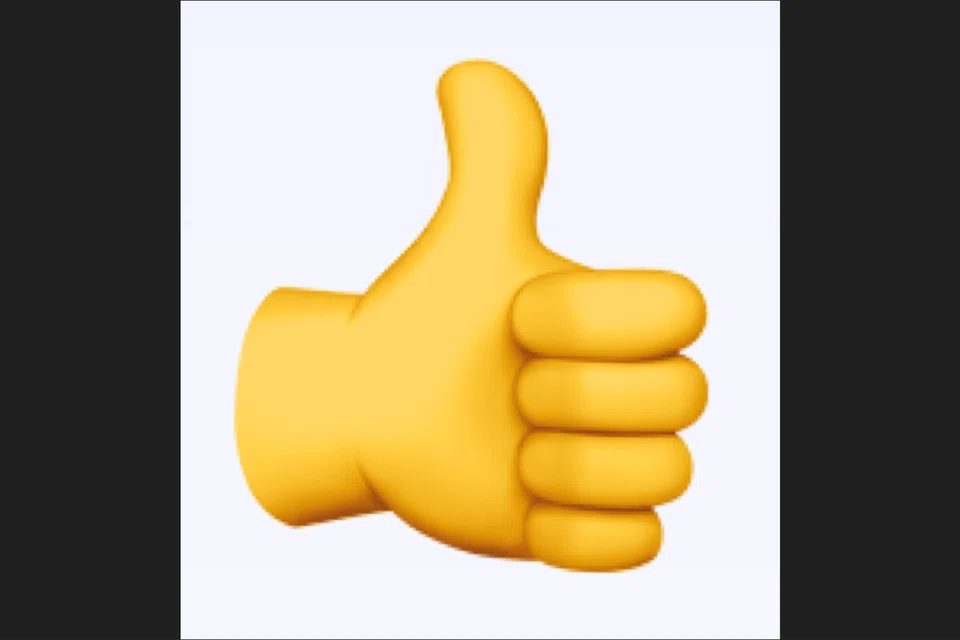

It comes as no surprise that the thumbs-up emoji emerged as the fourth most popular emoji used on Twitter, as reported by news outlets following a study into the most used emojis on social media.
The “thumbs-up” is a simple, universal symbol for agreement or approval. It is often used to say “great” or “all good”, and underscores the prevalence of hand gestures in human communication especially in many Asian and Mediterranean countries.
Incidentally, at the top of the emoji hierarchy is the “Face with Tears of Joy”, which symbolizes extreme happiness and uncontrollable laughter.
The Italians are perhaps the world leaders in hand gestures (the Greeks are a very close second). So much so that it’s sometimes jokingly said that the way to render an Italian speechless is to tie his wrists together – behind his back.
People resort to using their hands while speaking to emphasise certain points. I do it completely unintentionally when I’m really enthusiastic. My hands, sometimes, just fly.
Professor Spencer Kelly of Colgate University in the United States and co-director of the school’s Center for Language and Brain says that hand gestures come to us naturally.
He adds that even blind people use hand gestures when speaking to other blind people.
Other studies conducted at the University of Chicago suggest that gesturing not only helps others remember what you say, it also helps you speak more quickly and effectively.
As a test, try describing a spiral staircase without moving your hand.
Research shows that gestures enhance the effectiveness of spoken messages by more than 65 per cent, and that audiences are more convinced by what they see rather than what they hear.
“Politicians use (hand) gestures all the time to get their message across,” says Dr Hans Rutger Bosker at the Max Planck Institute for Psycholinguistics in the Netherlands.
Not everyone taps the power of body language, though, especially in this digital age.
When you consider that close to 90 per cent of the information our brains process during video calls comes from what we see, the question beckons: Why do we restrict ourselves to a tight headshot?
Rather, we should frame ourselves in a landscape format so that our arms are visible down to the elbows. Our audience can then see us using our hands to emphasise our points of view.
Of course, we should keep our gestures appropriate. Nothing too offensive or wild, please.
I’m nervous for those who are on the phone while driving. Even while using a headset, hand gestures for such individuals could have catastrophic ramifications.
By Khush Randhawa