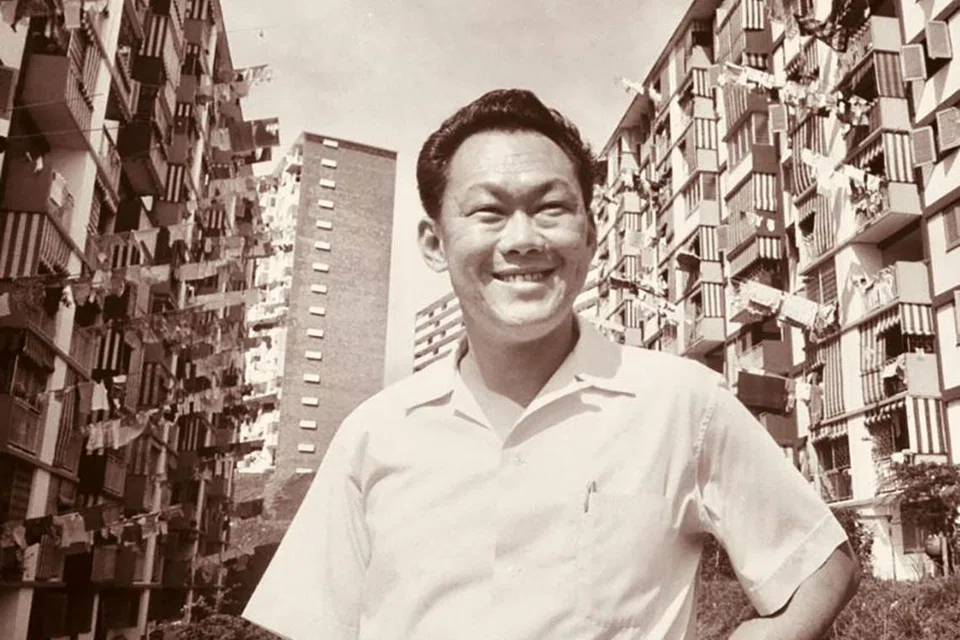

In 1995, Harvard Professor Samuel Huntington famously said of Singapore’s founding father Lee Kuan Yew that the “honesty and efficiency” which he had brought to the country were “likely to follow him to his grave”.
Mr Lee died this month in 2015. A decade from that miserable year, Prof Huntington’s thesis has not come true. That is because Mr Lee was not only an institution in himself – a man whose name was synonymous with that of the nation he had built – but was also wise enough to know that even the greatest leaders are born to perish one day but that the systems and structures which they build can outlast them.
Singapore has outlasted Lee Kuan Yew. That is the greatest tribute that Singapore can pay to him.
The institutions that Mr Lee built include the civil service, the military, the foreign service and the intelligence services. These vital sinews of the state uphold the good life in Singapore, a life sustained by the rule of law within national borders and by Singapore’s deterrent ability to protect those borders from predators, be they states or terror groups.
Of course, the good life is not equally good. But even to be old and poor in Singapore is not as terrible as it is in many other countries.
The system ensures that humans do not perish out of sight just because they cannot contribute to the national coffers any longer. They have contributed already – by being loyal citizens of this patch of land lying on the face of an anonymous and uncaring earth.
As for the other end of the economic spectrum, Singapore thrives because the talented best here thrive the most. True, the salaries commanded by bankers and other top-earning professionals in the private sector, who lay down a benchmark for salaries in the top echelons of the public sector, do appear astronomical to me.
However, the important thing is that those earnings are not made at the expense of the overall system – as in countries where wealth is a badge of corruption and nepotism for which the rest of society pays – but in the interests of that overall system.
The wealthy, through the taxes which they pay, create wealth for the rest of society, wealth that is distributed through public works and targeted subsidies.
That is why the system survives, a system founded on the non-negotiable premises of non-corruptibility and efficiency laid down and enforced by Mr Lee.
Whether it will continue to do so in the future depends on the ability of coming political leaders to fit his national vision into changing circumstances and not use circumstances to legitimate their departure from that vision. I am not speaking of the current leadership but of that which will succeed it in the years and decades to come.
I have hope that the continuity of Mr Lee’s ideas will endure beyond the first decade of his departure. That is because Singaporeans are a largely pragmatic people. They understand, although they do not always say so, that Singapore is a vulnerable state.
Its success attracts the ominous attention of larger and far-less successful countries. Hence, elite dissension in Singapore and the country’s consequent inability to deal with international discordance will cost Singaporeans dearly. When the international chips are down, the national chips become useless.
I stayed overnight at Marina Bay Sands Hotel with my family last week. We spent the evening at the infinity pool, where my son swam as his mother and I watched him. Then all three of us had dinner, walked around a bit, and went to our room.
As the lights atop the iconic buildings of Shenton Way came on at dusk, I was amazed at the existential resilience of Singapore’s financial skyline. Now in my 41st year here, this was the first time that I had witnessed the skyline from anything but below. I thought: How beautiful, but will all this last?
I do not see why it should not. Singapore will exist in an inhospitable world, but it will survive so long as it can attract the world’s best and brightest in the financial and scientific fields, so long as race and religion remain markers and do not become dividers on the road to national coherence, and so long as Singaporeans own Singapore and are not affiliated to foreign powers that seek to own their country.
A tall order? Not at all.
Singapore will survive Lee Kuan Yew – on his terms.