

The recent news of hundreds of migrant workers turning up at the Ministry of Manpower (MOM) office over unpaid wages by shuttered firms like KPA Engineering is deeply unsettling.
For these workers, who have left their homes and families in India and Bangladesh, missing months of salary is not just a contractual breach; it is a crushing financial blow that leaves their families back home struggling to pay for basic necessities and school fees.
Treating workers unfairly is ethically indefensible, but it is also a losing financial proposition for businesses.
Singapore maintains a zero-tolerance policy for worker abandonment and wage theft. The legal penalties are severe, and the state will not hesitate to prosecute errant employers, even when company directors attempt to flee the country.
However, this incident also underscores a critical area for improvement: the need for stronger, built-in regulatory mechanisms to detect payroll non-compliance much earlier.
Relying on workers to report missing wages after three or four months means that severe financial suffering has already occurred. Implementing automated, proactive tracking systems for salary payments would allow authorities to flag delinquent employers early, preventing such prolonged distress in the future.
What stands out in the wake of this distressing incident is the sheer speed and efficiency of Singapore’s tripartite safety nets. Within days:
- The Ministry of Manpower (MOM) and the Tripartite Alliance for Dispute Management (TADM) immediately stepped in to investigate, securing Special Passes for the affected men so they could legally remain and resolve their disputes.
- The National Trades Union Congress (NTUC) and the Migrant Workers’ Centre (MWC) mobilised rapidly. MWC members were given cash and FairPrice vouchers to tide them over, while MWC staff stepped up to provide daily meals.
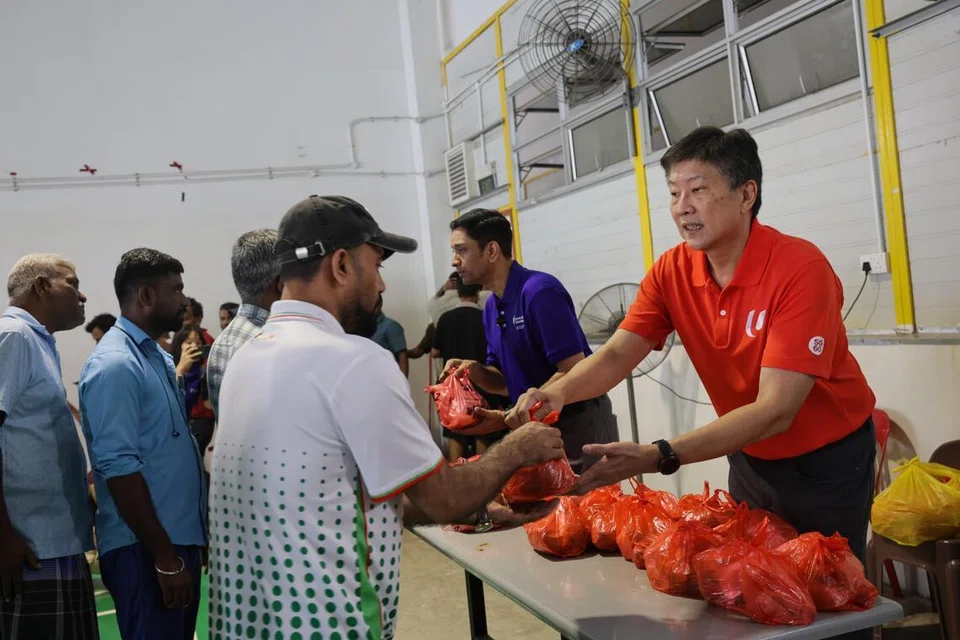
In a heartening display of ground-level care, NTUC Secretary-General Ng Chee Meng and Minister of State for Manpower Dinesh Vasu Dash personally visited the Tuas View Dormitory to distribute bags of lunch—curry rice with vegetables, fish, or chicken—and offer direct reassurance to the 400 affected workers.
Crucially, the NTUC has already sourced 40 firms with 150 immediate vacancies, aiming to match and re-employ every single worker who wishes to stay.
A Safer Environment
While there is always room for improvement, incidents like this highlight that Singapore remains a highly structured, safe, and measured environment for global talent.
Our robust welfare systems and commitment to worker well-being are further reflected in our broader national metrics, such as the workplace fatality rate, which fell to a record low of 0.96 per 100,000 workers in 2025.
Singapore’s message remains unequivocal: migrant workers are a vital part of our nation’s fabric, and the system will firmly protect their livelihood, dignity, and rights.