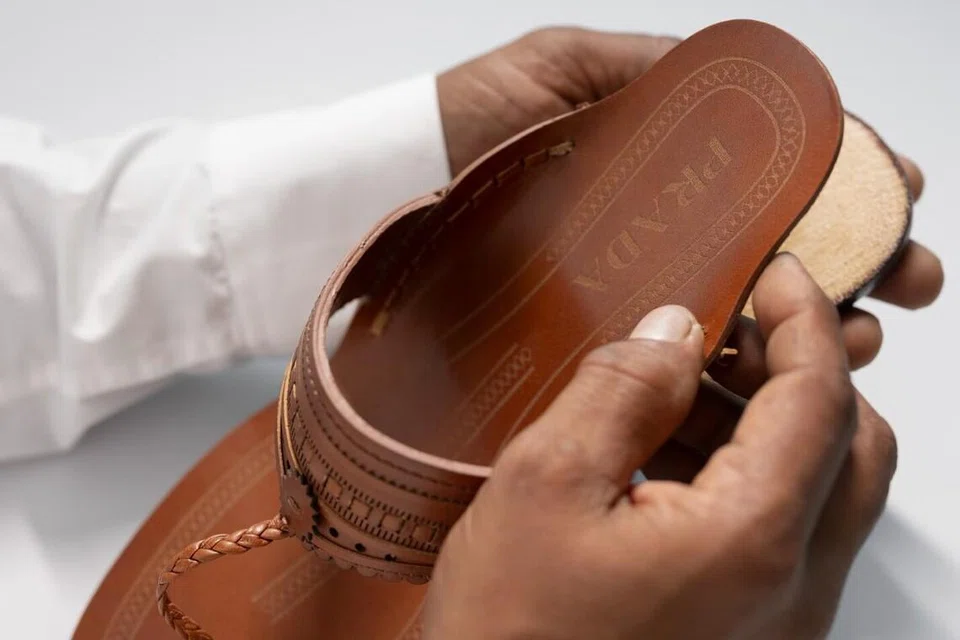

When Prada sent a pair of flat leather sandals down the runway at its Spring/Summer 2026 menswear show in Milan, they were introduced as just that – “leather sandals.” To most of the world, that’s all they appeared to be. But to many in India, they were unmistakably Kolhapuri chappals – a centuries-old design with a living lineage of artisans and cultural identity.
What followed was accusations of cultural appropriation, criticism from artisans and politicians, and a broader reckoning about who gets to profit from heritage.
Kolhapuri chappals are geographically protected (GI-tagged), historically rooted, and labour-intensive, often handmade by artisans in Maharashtra and Karnataka over the course of a few weeks.
So when a luxury brand presented a near-identical silhouette without attribution, at prices exponentially higher than what artisans earn, it understandably struck a nerve.
The backlash also exposed a familiar asymmetry in global fashion. Traditional crafts are often invisible until stolen by the West, at which point they become “discoveries” rather than an intentional spotlighting of the original craft.
Nearly a year after the controversy, Prada has launched a limited-edition line of Kolhapuri-inspired sandals made in India, developed in collaboration with local artisans and state-backed organisations.
The initiative includes localised production in regions where Kolhapuri chappals are traditionally made, partnerships with artisan bodies, a three-year training programme expected to support around 180 craftspeople, and opportunities for artisans to train in Italy at Prada’s own academy.
On paper, this looks like meaningful course correction, moving from appropriation toward collaboration. However, Prada’s response cannot be taken at face value.
On one hand, the collaboration could bring global visibility, better wages, and institutional support to artisans who have long struggled with declining markets and low margins.
Kolhapuri craft, like many traditional industries, has faced economic precarity despite its cultural value.
On the other hand, the sequence of events matters. Recognition of Indian craftspeople came only after backlash, and the push toward collaboration only followed criticism of the original presentation.
It would not be unreasonable to suggest that this partnership was shaped, at least in part, by external pressure.
This pattern isn’t unique to Prada. South Asian culture has often been selectively borrowed from and rebranded in global fashion contexts. Be it adorning one’s face with bindis at music festivals and calling it “boho festive wear” or wearing gowns with a shawl draped over one’s decolletage and calling it a “Scandinavian scarf” instead of what it actually is – a dupatta.
In many cases, cultural heritage enters global fashion through a cycle – uncredited adoption followed by public backlash, often concluding in retrospective collaboration.
This controversy has now reached Ralph Lauren, the luxury American label currently selling a “tie-dye print” cotton skirt.
While the fine print describes the piece as featuring a “vibrant design inspired by traditional Bandhini tie-dye techniques and motifs,” it notably omits any mention of the craft’s origins.
For those who are unfamiliar, the manufacturing of Bandhani – one of India’s oldest textile arts, primarily from Gujarat and Rajasthan – is an intricate process. It involves tying thousands of tiny knots in fabric before dyeing, producing the distinctive dotted patterns.
Priced at nearly S$700, the skirt highlights a stark disparity between luxury retail markups and the meagre earnings of traditional artisans who have practised this craft for generations.
Unsurprisingly, many Indians have voiced their frustration. Comments across social media reflected a unified concern: “A heritage craft becomes luxury, but the original creators are invisible?” and “(We) really need to call them out for stealing our traditions.”
The double-edged sword of global attention
The Kolhapuri chappal has always been global – it travelled through trade and adaptation long before it reached a runway in Milan. What’s changing now is not the object itself, but the terms of engagement.
If Prada’s next chapter is to amount to anything, it will depend on its ability to rewrite a long-standing imbalance rather than how many Kolhapuri chappals it sells.
True change would mean embedding these considerations at the point of creation rather than addressing them after the fact. Until then, these storied crafts will remain luxury’s favourite aesthetic, but craftspeople will continue to remain in the shadows.