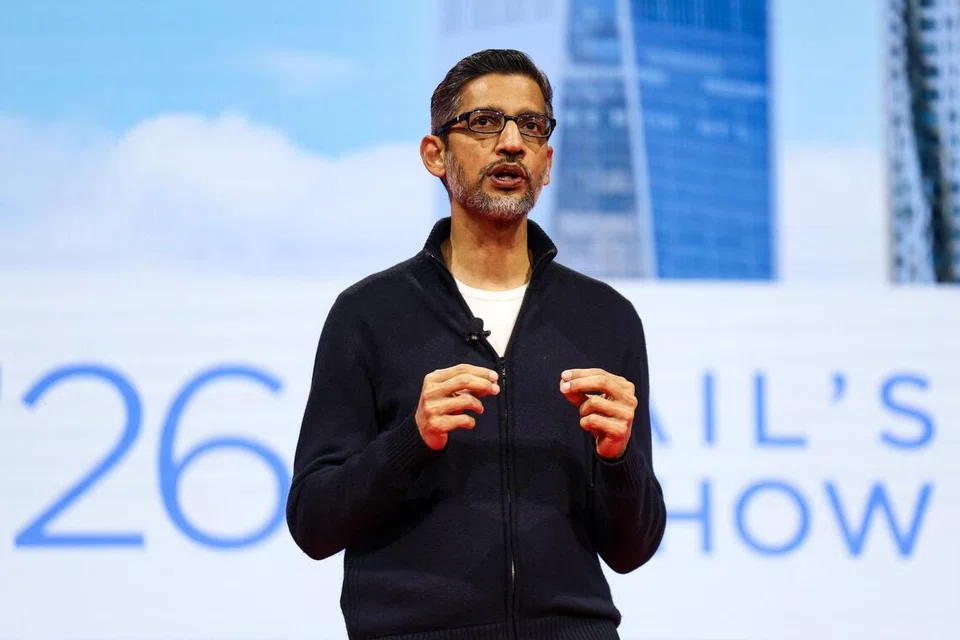
Every year, the CEO of Google stands on a stage and speaks to millions of developers. I watched the speech he made recently on YouTube, but as soon as he started, I had to pause his pontificating and open a dictionary in a different window.
Here’s what I heard: “Google is fully in our Gemini era… We’ve been investing in AI for more than a decade – and innovating at every layer of the stack… We are in the early days of the AI platform shift… A frontier model, built to be natively multimodal from the very beginning.”
Awesome right? But wouldn’t it be even more awesome if you could understand it, especially if, like me, you’re not a tech bro. Having done the hard work, let me save you the trouble and translate it, bit by bit, from Pichai jargon to normal English.
“Google is fully in our Gemini era.”
An era is a period of time in which the history of the Earth is measured. Pichai is saying that there was the dinosaur era, the stone age era, the Renaissance era, and now we’re in the Gemini era.
And here’s the wondrous thing: while you and I are merely in the era – perhaps only 24.6 per cent in – Google is fully in.
I was blown over by that knowledge. I’m sure you are, too.
“Innovating at every layer of the stack.”
If you’re a working professional, of course, you know what “innovating” means. You’re probably doing it day in and day out, even if it’s sometimes innovating a new way to go on “medical leave”.
So, let’s get to the second part. Most companies just innovate… but that’s so yesterday. At Google, they do it in layers and stacks, very similar to making lasagne.
Place the pasta sheet, then innovate one layer. Maybe tomato? Maybe brinjal? Maybe both? Then add one more pasta sheet. Then add one more innovation… and so on.
It’s exactly like that in Google – only it’s with technology. I hope that’s crystal clear now?
“We are in the early days of the AI platform shift.”
This is easy. Pichai is saying AI is a platform like the stage on which he made the speech, and it’s beginning to shift. Where from and where to, he doesn’t say. I assume that’s proprietary Google information.
“A frontier model, built to be natively multimodal from the beginning.”
Okay, this one is tough, and I will need you to stay with me. Basically, there are three types of AI models: cavalier, buccaneer and frontier. Gemini belongs to the last category.
Each model can be designed as single-modal, dual-modal or multi-modal. Gemini chose the multi-route. And this can be done in two ways – natively (like Gemini does it) and non-natively.
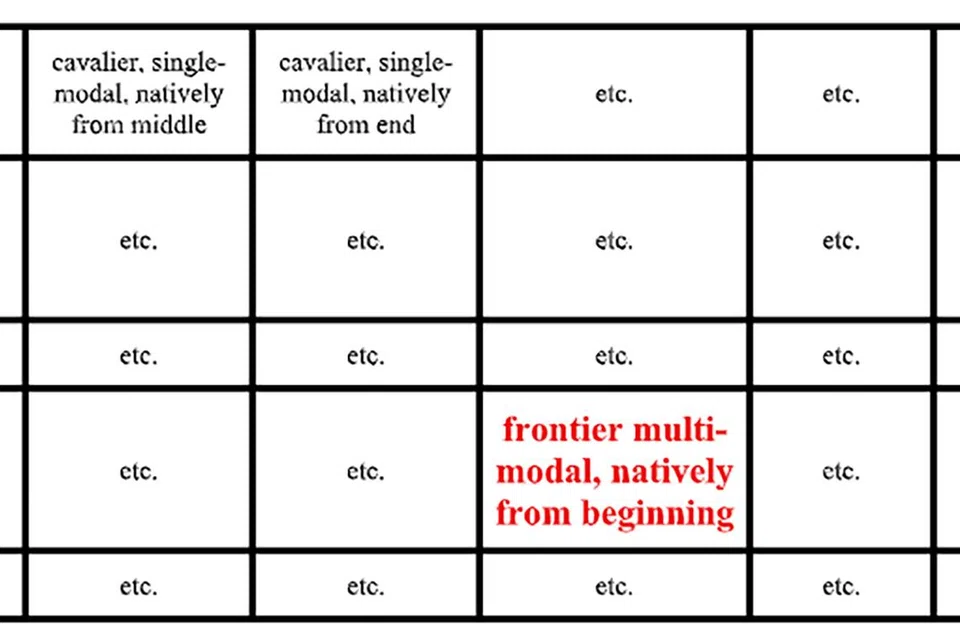
And while Gemini had designed it like this from the beginning, you could also wait and do it in the middle or the end. In other words, there are 54 mathematical permutations, a few are captured in the chart above.
You don’t have to grasp the whole chart. I’ve helpfully highlighted the Gemini situation – that’s all you need to understand. Super clear, right?
You may be wondering: why do business titans talk like this (the full speech is here: www.youtube.com/live/XEzRZ35urlk)? Don’t they want to be understood? No! They don’t want you to understand everything – or even anything – they want you to know something important just happened in highbrow tech land.
If Mr Pichai wanted to be understood, he could have said: “Folks, Google has been committed to AI for over ten years, and we’re investing heavily in Gemini. We’ve put in many innovations into this platform that we’ll be sharing today.”
If you agree that’s a bit clearer and want to write like that it’s easy: use the English you learned in school. Avoid the stuff you read every day at work – in emails, on company charters and in PowerPoint presentations.
Surely we can learn from Albert Einstein to explain complex matters in simple terms, and say “this isn’t working” instead of “a strategic pivot”.
Mr Einstein is often (and perhaps generously) quoted as explaining relativity like this: “When you sit with a nice girl for two hours, you think it’s only a minute. But when you sit on a hot stove for a minute, you think it’s two hours. That’s relativity.”
Paddy Rangappa, an ex-CEO, is a humour writer, co-host of the podcast Jest Business, and corporate coach on humour for leaders (www.jestbusiness.com)