Just days into my new life in Singapore, I was delighted to find an elderly Sikh gentleman driving our cab. The prospect of speaking Punjabi, my native language, outside India thrilled me.
But he looked grim, his eyes fixed firmly on the road. As the ride ended, I gathered the courage to address him in Punjabi. He replied in fluent English: “I am a Singaporean and have no connection with mainland India.” His matter-of-fact response, delivered with quiet calm, left me taken aback.
I dismissed it as a one-off incident. Days later, on a lazy Sunday evening walk to Bukit Gombak Stadium, I was drawn into a thrilling football match. The word Khalsa on the players’ jerseys caught my eye. A Sikh football team in Singapore? I was intrigued.
The team belongs to the Singapore Khalsa Association (SKA), founded in 1931 by Sikh schoolboys passionate about sport. Today, SKA is a larger “community institution”. I also discovered other Sikh football teams, including Balestier Khalsa, which plays in Singapore’s top league. Impressive, I thought.
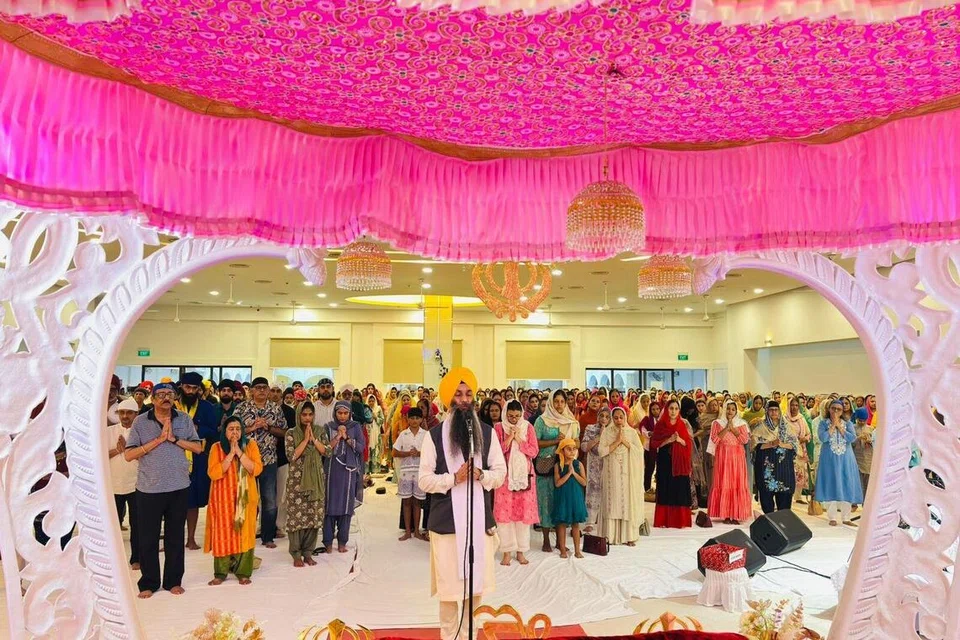
In fact, the Sikh community had a far larger footprint than I imagined. Schools, gurdwaras (places of worship), welfare organisations, boards and associations — an entire ecosystem for roughly 12,000 Sikhs in a country of over six million. How has such a small community retained its strong identity and structure?
“Taking initiative is our second nature,” said 36-year-old Ravin Singh, a fintech professional who founded the Singapore Sikh Professional Network during Covid to offer young people professional guidance, emotional support and empathy.
The more I learnt about the community, the more I came across committed, passionate individuals who gave their time voluntarily despite hectic day jobs.
Ms Harpreet Kaur, who heads SKA’s Media and Communication committee while working at the National University of Singapore’s Institute of South Asian Studies, said, “We want our future generations to know that there is another home within this home that empowers and supports them, without them feeling segregated.” These days she is busy popularising SKA Awaaz, a community podcast channel.
Another entity is the Sikh Centre, established in 2000, that keeps Sikh culture alive through language, music, dance and other activities.
Like any community, generational differences are evident. Older Sikhs often retain stronger ties to Punjab through family, language, travel and gurdwara life. For them, the focus was on survival, making a mark and leaving a legacy.
Younger Sikhs, many with Singapore-born parents, shape their identity differently. In fact, some young Sikhs feel burdened by this legacy. “The youth today are facing different sets of challenges of navigating a digital world and managing peer pressure require a new kind of resilience,” said Mr Harishpal Singh Grewal, a bank project manager and president of the Young Sikh Association (YSA), established in 2003 to guide young Sikhs professionally.
Sports and youth forums help keep the young people connected. “It gives them a sense of focus and purpose and also binds them together,” said Ms Harpreet. For SKA, sport remains central to its founding mission, with a football academy, sponsored teams and players, and tournaments.
A key institutional link with the Government is the Sikh Advisory Board (SAB), appointed by the Ministry of Culture, Community and Youth (MCCY). “We help the Government in communicating new policies to the Sikh community, while also seeking its support to preserve our identity,” said SAB chairperson Malminderjit Singh. He is identifying younger candidates for MCCY to consider for the 17-member board.
What stands out about this small Sikh community is how it has retained what matters while finding new ways to connect with wider society.
So I finally asked, what does being Singaporean mean to this community? “It has meant everything. Being part of a multicultural society that respects meritocracy, values action and believes in leaving no one behind is simply wonderful,” said Mr Malminderjit Singh, whose grandfather, a revolutionary in British India, was sent to Singapore as a prisoner and lived beyond 100. Many Sikh citizens, he said, consider themselves “thoroughly Singaporean”.
I think back to the Sikh cab driver and the young footballers I watched that Sunday evening. The question is not whether they are Sikhs who are Singaporeans or Singaporeans who happen to be Sikh, but how they make “being both” seem so natural.
And that was my “aha” moment: identity need not mean choosing one over another. Sometimes, it is simply about being both. Perhaps like the “Ek Onkaar” (one formless divine) the Sikhs pray to, there is a quiet strength in being one and another at the same time.
Shubhra Puri is the Founder of Gurgaon First (www.gurgaonfirst.org), a social enterprise with a vision to make Gurugram a sustainable, empowered and inclusive city. Shubhra began her career as a business correspondent with The Economic Times in Delhi after completing her Postgraduate Diploma in Business Studies. For 15 years, she served as Editor of Power Line and India Infrastructure magazines.