The shortest route from Point A to Point B is a straight line. Singaporeans understand this instinctively. Why else would we have turned acronyms into a national language?
HDB. CPF. MRT. ATM. GST. ERP. COE. MOE. MOM. ICA. IRAS.
And just when you think we have reached the limit, along comes iFWLB for the Internet Foreign Worker Levy Billing system.
Good luck pronouncing that one.
Even Singapore Airlines has joined the shortcut race. It became SIA, but now it is often further reduced to SQ. One letter saved.
That is the Singaporean principle: If something can be shortened, why use the long version?
And our love of shortcuts goes far beyond language. It extends to our feet.
Visit any HDB estate, and you may see a perfectly good paved walkway connecting two blocks. But it takes only one resident to notice that walking diagonally across the grass could save 10 seconds.
So that person does it. Then another follows.
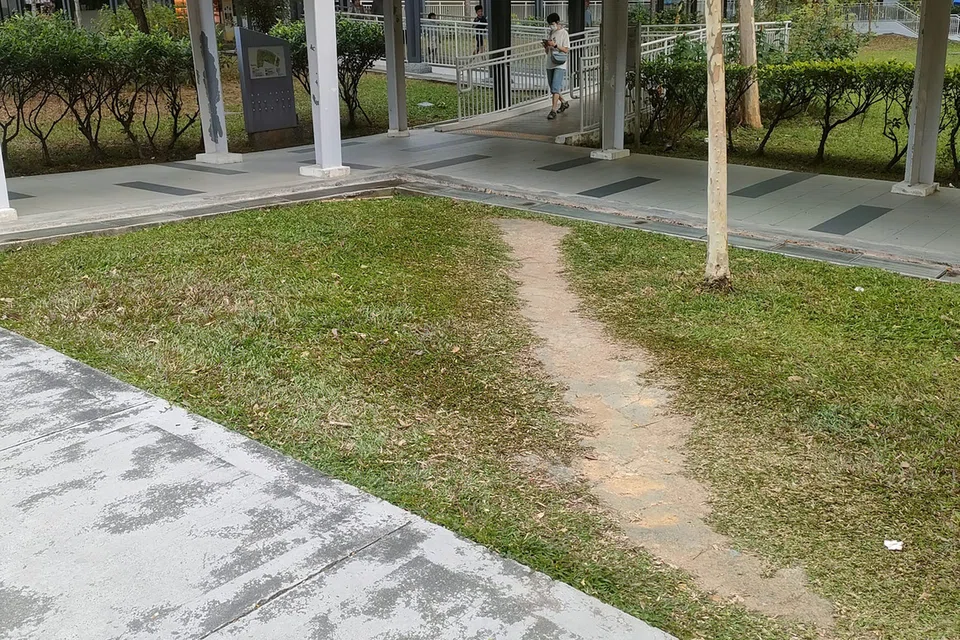
Soon, a steady stream of shortcut enthusiasts has created a dirt track across the grass.
Congratulations! Singapore has acquired a new footpath without spending a single cent on construction.
For many of us, this is not laziness. This is optimisation, Singapore-style.
We are perfectly capable of queuing for 30 minutes for cheaper chicken rice. We will walk to three supermarkets to compare prices. But ask us to walk an extra three metres on a proper path when a patch of grass offers a diagonal route, and suddenly every second counts.
The grass, unfortunately, does not understand optimisation. It only knows that hundreds of pairs of shoes are marching across it.
Eventually, it surrenders. A neat green lawn develops an ugly brown scar running straight through it.
The photograph above tells the story.
But these unofficial pathways are telling us something useful.
They show where people actually want to walk, rather than where urban planners assumed they wanted to walk.
Perhaps the answer is not another stern sign saying: “PLEASE KEEP OFF THE GRASS”.
Singaporeans are not particularly impressed by signs telling them what not to do. If anything, a sign can sometimes turn an ordinary patch of grass into a challenge.
Instead, planners could observe where people walk, identify the most popular shortcuts, and where appropriate, pave them properly.
It would be an almost perfect Singaporean solution: Observe the shortcut. Improve it. Make it official.
Why fight human behaviour when you can infrastructure it?
Of course, the Singaporean shortcut does not stop at our feet. It has invaded our conversations: “Going? Can. Where? Joo Koon. Dinner? Already. Tomorrow? See how.”
We are not being unfriendly. We are saving bandwidth. For what, I am unable to fathom.
Our obsession with efficiency means time is treated almost like currency. We have apps telling us when the bus will arrive, how long the journey will take, how long the queue is, and how many minutes remain before our food is ready.
We also don’t merely want to get there. We want to get there faster and with less effort. We don’t merely want to say something. We want to say it with fewer words.
We don’t merely want a solution. We want a better, cheaper, faster solution that can also be abbreviated to three letters.
That is Singaporean efficiency in a nutshell.
Or, to put it more succinctly, SG loves shortcuts. Bring ’em on!