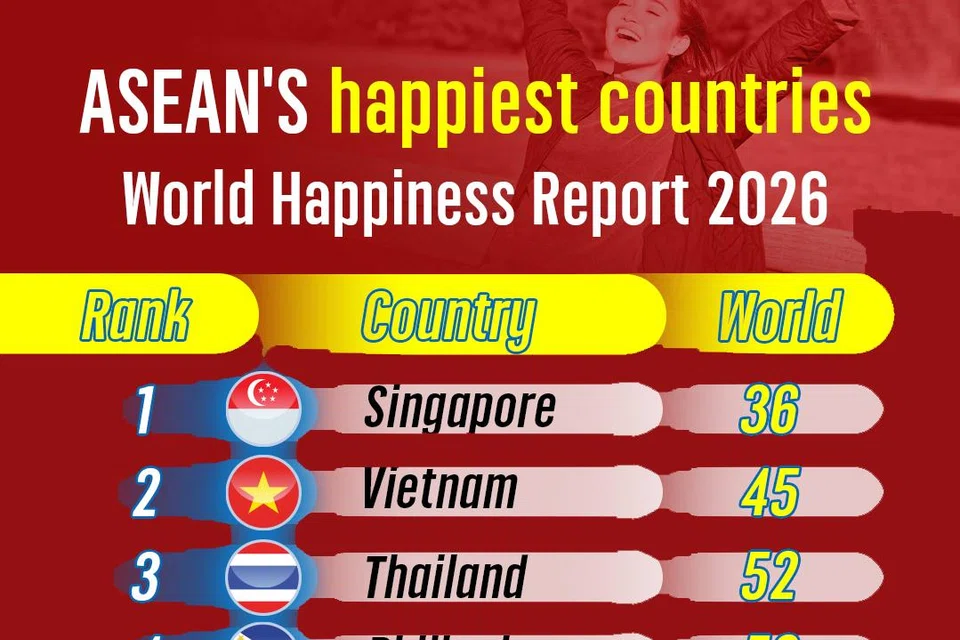

According to global research firm Ipsos, happiness levels across Southeast Asia are on the rise except in Singapore.
Indonesia has taken the top spot globally. Malaysians are reportedly becoming increasingly cheerful by the day. Meanwhile, Singapore, although efficient, prosperous and impeccably organised, finds itself lagging behind.
This is, to put it mildly, puzzling. After all, it takes a fair bit of effort to remain unhappy in one of the safest, cleanest, and best-run countries in the world.
As Home Affairs Minister K. Shanmugam noted during a recent dialogue with students at Nanyang Technological University, happiness begins with peace and security. Without these, any talk of happiness is theoretical at best.
These are areas where Singapore has laid a formidable foundation. Add access to quality education, affordable housing, reliable healthcare, good governance and economic opportunity, and the ingredients to enjoy a good, happy life are clearly present.
Which is why a question posed during that session stood out: “How does the government support us in our pursuit of happiness?”
Minister Shanmugam’s response is both simple and profound. He points out that happiness is shaped by our purpose and perspective. These are deeply personal forces that no policy can engineer.
In other words, the government may provide the ingredients, but the recipe for attaining happiness is entirely ours.
As in the words of the Greek philosopher Aristotle: “Happiness depends upon ourselves.”
In a society that prizes grit, pragmatism, and meritocracy, the question can sound like outsourcing emotional well-being to the government.
Many Singaporeans readily admit that they are not unhappy because life is bad. Life is quite good, but “quite good” is simply not good enough.
In a way, our dissatisfaction is a by-product of our track record. When things work well most of the time, even minor imperfections give rise to complaints.
Consider the government’s Community Development Council (CDC) vouchers. Conceived as a buffer against rising living costs, they are both warmly received and relentlessly scrutinised.
The sums are deemed helpful but never quite enough. The spending categories are appreciated, yet somehow too restrictive. The roll-out is efficient but still not good enough.
The overall verdict? Must do better next time.
Then there is our enduring national fixation: housing. Young couples lament the prices of new Housing Board flats, even as application rates routinely outstrip supply.
HDB upgraders shake their heads at soaring condominium prices, while confidently setting ambitious asking prices for their own resale units.
And condo owners, eyeing the next rung on the property ladder, bemoan the escalating cost of a landed home.
Yet, curiously, this shared unhappiness has evolved into a kind of social glue. It binds us across income groups, generations, and postcodes.
These complaints are short, sharp, and strikingly uniform and can be applied to nearly everything. This includes the prices we pay for groceries and services, as well as what it costs us to eat at hawker centres and restaurants.
“Wah, so expensive.”
“Why like that?”
“Gahmen must do something!”
So yes, Singaporeans may be demanding, kiasu, and perpetually dissatisfied. But that may be precisely the point.
In our own efficient, mildly exasperated, and unmistakably Singaporean way, that might just be our version of happiness.