
The festival season in Singapore never seems to take a break.
The city is a buzzing mosaic of cultures and, as the days go by, it feels like you’re living in an endless loop of food, prayers and more food. Except that, instead of Groundhog Day, it’s Ganesh Chaturthi, Onam, Kailpodh, Navaratri, Deepavali – all in rapid succession.
The multicultural calendar: Why stop at one festival?
In Singapore, festivals seem to come at you like buses. You wait for one and then six arrive at the same time, each with its own dietary restrictions, dress code and volume settings.
This year, I finally made peace with the fact that, for nine months of the year, our weekends belong to Netflix, and for the other three, they belong to the Gods.
Take Ganesh Chaturthi. Most communities love our Sukh Karta, Dukh Harta, roly-poly Elephant God riding on his cute mouse. For decor, we are talking massive, lovingly-decorated Ganeshas taking over every corner of the house.
Then comes the long list of relatives, each with her own version of how to perfect the modak. You just need to nod at every aunty appreciatively and eat the yummy modaks before they disappear – the modaks, I mean, not the aunties.
But, before the last crumb of Ganesh’s offering has even been consumed, Onam storms in.
Onam: The home stretch... and the banana leaf
Onam is like the Malayalam version of Thanksgiving but on steroids.
You’ve got to cook a 20-dish Onam sadhya – a feast served on banana leaves, with no cutlery allowed. Luckily I do not cook, I only eat.
Onam also involves dressing up in the traditional white and gold sari, except here’s the rub: After days of eating festival food, no sari is designed to hide what the payasam has done to your waistline!
Navaratri: The festival of dolls and dance
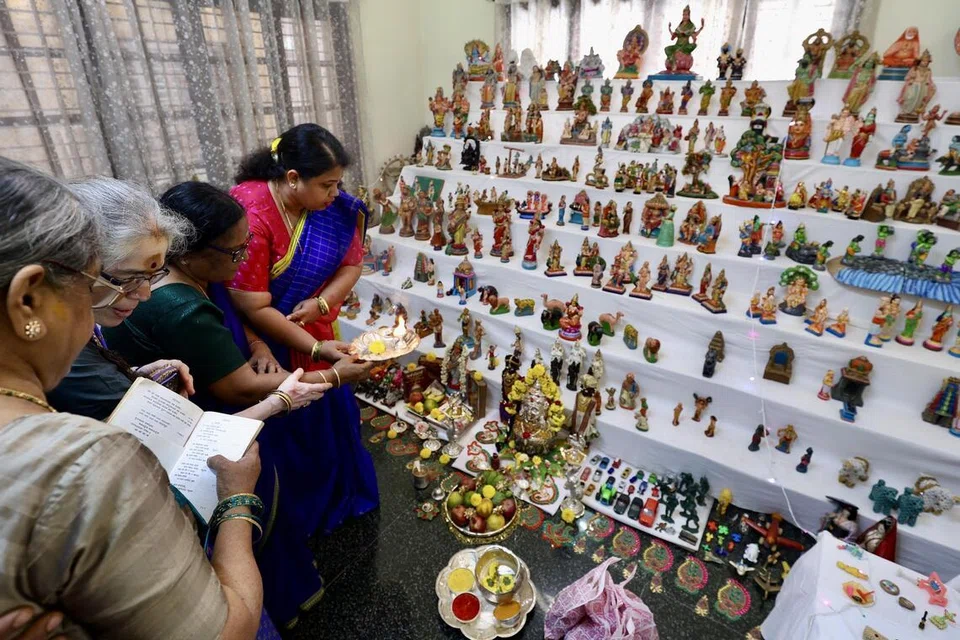
Navaratri isn’t just about fasting and prayers, it’s also the time for golu, a tradition where dolls of gods, goddesses and sometimes random animals are arranged on a multi-tiered platform. It’s basically a miniature version of Indian mythology meets DIY arts and crafts.
Each year, dolls are dug up from storage. Some dolls are chipped, others look like they have been through the wars, and there’s always the odd rogue animal figure that’s somehow squeezed in.
This year’s surprise? A Barbie doll someone’s child added to the display, right next to Lord Krishna.
Navaratri is its own universe. Nine days of fasting, feasting, dressing up, singing Mataji Na Garba and dancing in huge crowds, getting hit in the wrong places by dandia sticks! Jai Ambe!
Deepavali: A higher level of celebration
And just when you think you’ve made it through the whirlwind of pujas and prasad, Deepavali is just around the corner, the final boss of the Indian festival season.
Little India lights up with huge peacock decor, shops glow with decorations and aunties are out in full force, discussing this year’s sari trends as if it’s a competition to out-sparkle the lights themselves.
The preparation is another level altogether. Homes, for instance, are scrubbed from top to bottom – because, apparently, Goddess Lakshmi checks every corner before deciding if you’re worthy of her blessings.
New clothes are bought and plans for elaborate, catered meals are enthusiastically discussed.
Meanwhile, the kids are interested only in how many sparklers and fireworks they can set off without parental intervention.
The beauty of celebrating Deepavali in Singapore lies in its community spirit. From organising rangoli competitions to potluck dinners, it’s an experience that binds everyone in the joy of togetherness – even if we are all simultaneously navigating traffic jams to get from one gathering to another.
Survival tips for festival frenzy
So, how does one survive this Singaporean festival frenzy? Well, here are a few lessons I’ve picked up:
Learn the art of timing: Every family member will tell you that each festival has “just one important day”, but they are lying.
Festivals stretch into weeks: Pace yourself. It’s not a sprint, it’s a marathon – with plenty of fried snacks at every rest stop.
Master the multi-cuisine cook-off: At one point, you’ll have to balance modak, vadai, payasam, all on the same day. Channel your inner MasterChef, or better yet, find a good caterer.
Sari superpowers: Invest in good sari pleats and stronger safety pins. You’ll need them when sprinting between Navaratri golus and Onam sadhyas.
Conclusion
In Singapore, where every community takes its festivals seriously, it’s easy to feel overwhelmed. But, once you embrace the chaos, there is a certain joy in seeing how these traditions collide, overlap and create new memories.
And, if nothing else, there’s always next weekend to recover!
Oh, what’s that I hear already? Jingle bells, jingle bells playing in the malls...