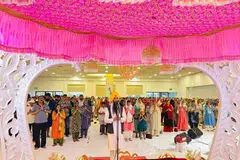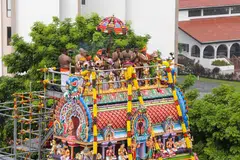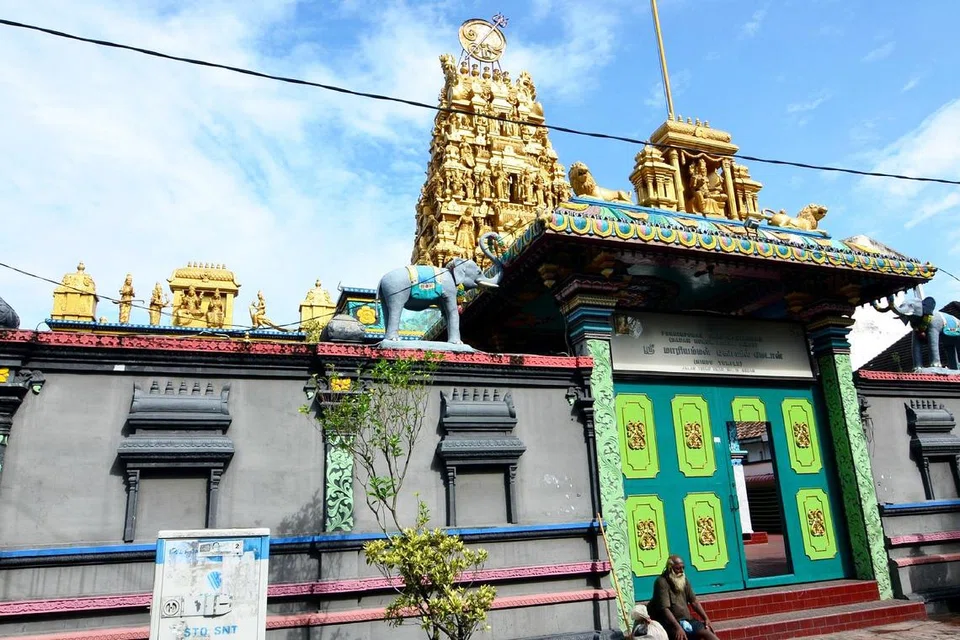

On a single stretch of road in Medan, the call to prayer rises from Masjid Raya Al-Mashun even as bells ring at Sri Mariamman Temple and incense drifts through Vihara Gunung Timur and the nearby Gurudwara. Not far away, Graha Maria Annai Velangkanni Church draws worshippers with a devotion that feels deeply local.
This is not curated diversity. It is simply how the Indonesian city lives - layered, overlapping and unforced.
Within this landscape lies Kampung Madras, a district shaped by 19th-century migration, when Tamils from Thanjavur and surrounding regions arrived to work on the Deli tobacco estates.
Today, the Indian-Indonesian population in North Sumatra is estimated between 40,000 and 75,000, largely Tamil, though exact figures remain uncertain. From labourers, many moved into trade, building a distinct yet porous enclave.
The past lingers in subtle ways. Madam Krishnaveni, 68, who helps her daughter run a local Indian eatery, recalled: “The streets formerly known as Calcutta, Bombay, Ceylon and Madras may have been renamed, yet their older identities persist in everyday speech.”
Memory, here, does not announce itself. It settles quietly into habit.
In Kampung Madras, identity is not preserved behind glass, it is lived. Ms Kalaivani, 46, a third-generation Tamil, runs Sabaas Indian Food, where roti canai, murtabak and thosai move briskly from kitchen to table.
Trained by her grandmother from the age of 10, she now runs a catering business to support her daughters’ education abroad.
“Our food is Indian, but the process has changed with Medan,” she said. “That is how we live too – holding on, but also adapting.”
Adaptation extends beyond the kitchen. Intermarriages blur cultural lines; Malay spouses adopt Tamil customs, wearing the thali and marking Tamil New Year with sweet rice.
Even ritual practices travel in unexpected ways. Bottled cow urine, sold not only in Indian shops but in Pasar Petisah market, reflects this continuity. As temple visitor Sivaaraju explained: “It is not just for cleaning. It is used in rituals and believed to drive out evil spirits.”
Language, too, shifts with circumstance. “My Tamil is softer now,” said Mr Krishna, who spent years working in a Punjabi textile shop. Yet, continuity persists: “I still pray to Murugan and Kali as my parents did. That will not change.”
For elders like Mr Krishnan, in his late 70s, change is measured over decades. With roots in Tiruvarur (a historic municipal town in Tamil Nadu), he remembers when the temple was little more than an attap structure. “In those days, it was small, just enough for prayer. Now it has grown with us.”
Today, the temple stands ornate and expansive, its sculpted deities and marble floors reflecting not just devotion, but the community’s own journey. It is no longer merely a place of worship, but a social anchor, where rituals, marriages and memory converge.
Festivals give this continuity its rhythm. Thaipusam spills into the streets with kavadi processions; Deepavali lights up homes and storefronts; Tamil New Year arrives with bright banners and shared meals.
“These are not performances,” said Mr Krishna. “This is our life.”
Such celebrations are not staged for spectacle. They structure time, reinforce belonging, and quietly invite participation across communities.
If faith anchors identity, food carries it forward. Medan’s Indian cuisine is not a replica of the subcontinent but an evolution, shaped by local ingredients and neighbouring influences. Curries take on subtle Malay notes; street-side roti canai reflects both familiarity and change.
“People come for the taste,” Ms Kalaivani said, “but they also come for something familiar.”
A meal here is not about strict authenticity. It is about continuity – heritage adjusted, but not abandoned.
What emerges in Medan is not preservation in isolation, but identity in motion. The Tamil community retains its core: faith, food, family and festival, while allowing each to be reshaped through encounter.
In a world where multiculturalism is often debated in policy terms, Medan offers a quieter truth. Cultures do not stand apart as symbols to be managed. They meet in kitchens, markets, marriages and shared streets – sometimes blending, sometimes holding their ground, but always aware of one another.
The story of Indian life here is not merely one of migration. It is one of endurance, adjustment and quiet confidence.
In Medan, identity is neither rigid nor diluted. It is lived daily, visibly, and without proclamation. And perhaps that is its most enduring lesson: Harmony does not come from standing apart, but from learning, over time, how to live closely without fear.
Rhama Sankaran is a freelance journalist.