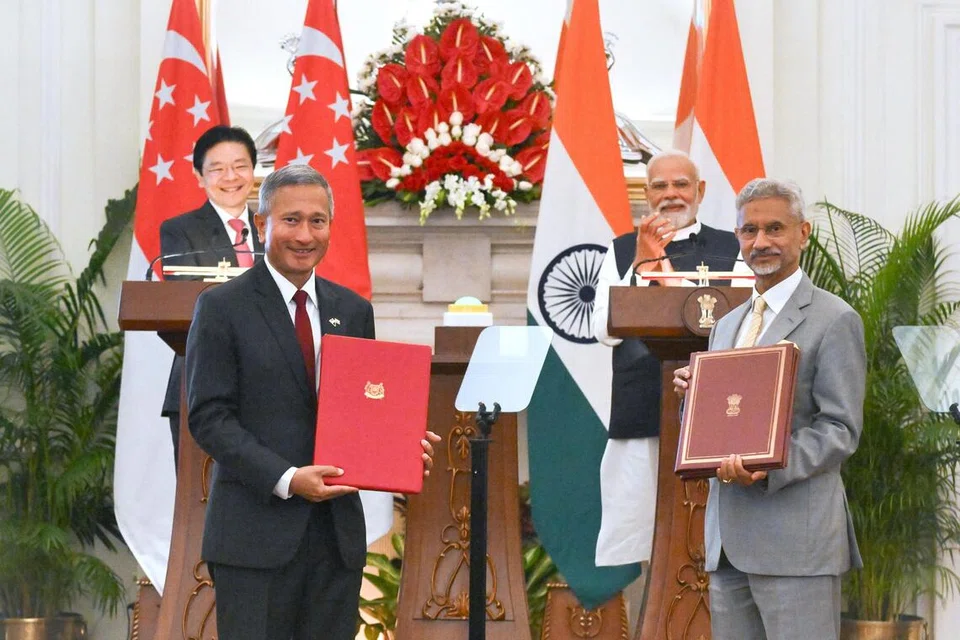

As India and Singapore commemorate the diamond jubilee of their diplomatic relations, the partnership stands as a testament to strategic foresight and adaptive statecraft.
Forged in the anxious aftermath of independence and tempered by the pressures of a changing global order, this relationship has matured into one of Asia’s most vital and multifaceted alignments.
Its significance, however, extends far beyond the bilateral; India-Singapore relations proffer a compelling template for regional stability and a powerful engine for prosperity in an emerging Asian century.
This remarkable evolution from post-colonial cordiality to comprehensive strategic partnership reflects a profound convergence of interests, a journey of two nations leveraging on their unique strengths in the spirit of pragmatic cooperation.
The pivotal turning point arrived with India’s epochal economic liberalisation in the 1990s. Singapore, a known global node of trade and finance, instantly recognised the opportunity presented by a reforming, opening India.
This mutual recognition was crystallised into a new architectural bilateral framework as shown by the landmark India-Singapore Comprehensive Economic Cooperation Agreement (CECA) of 2005. More than a mere trade deal, CECA was a pioneering and integrated compact covering goods, services, investment, and financial flows.
It became the blueprint for India’s subsequent international trade agreements and served as the turbocharger for the bilateral relationship.
Today, with bilateral trade exceeding US$35 billion (S$45 billion), Singapore firmly stands as India’s largest trade and investment partner within ASEAN and a critical gateway, channelling over a fifth of all foreign investment into India.
To be sure, the contemporary partnership operates on three robust and interconnected tracks: economic, defence, and digital. Economically, the engagement has deepened beyond conventional trade.
Singaporean sovereign wealth funds like the Government of Singapore Investment Corporation (GIC) and Temasek are long-term investors in Indian infrastructure, technology, and renewable energy.
A powerful synergy fuels the innovation ecosystem: Indian start-ups increasingly utilise Singapore’s stable legal framework and vast pools of venture capital as a springboard for global expansion, while Singaporean firms and investors gain access to India’s vast market and deep reservoir of digital talent.
This is a relationship that has moved far beyond simple transactions to one of deeply intertwined corporate destinies.
Looking towards the future, the trajectory for this partnership is set for further elevation, though it is not without its challenges. The opportunities, however, are immense and historically significant.
Singapore’s unrivalled expertise in logistics, finance, and global connectivity, combined with India’s vast domestic market and burgeoning manufacturing capabilities under initiatives like Production Linked Incentives (PLI), can jointly position the duo as a compelling alternative manufacturing and export platform for the world, due to the ongoing global reconfiguration of supply chains.
Recent dialogues, such as the India-Singapore Ministerial Roundtable, which focus on collaboration in skill development, the green economy and digital connectivity, are timely steps to harness this potential.
From the cautious beginnings of 1965, and the occasional difficulties of doing business in India due to red tape, India-Singapore relations have rapidly grown into a comprehensive bond that is indispensable to the security and economic futures of both nations.
As the world navigates an era of profound geopolitical shift and economic uncertainty, the India-Singapore partnership stands as a beacon of stability and opportunity.
(Dr Mustafa Izzuddin is a senior international affairs analyst with Solaris Strategies Singapore.)