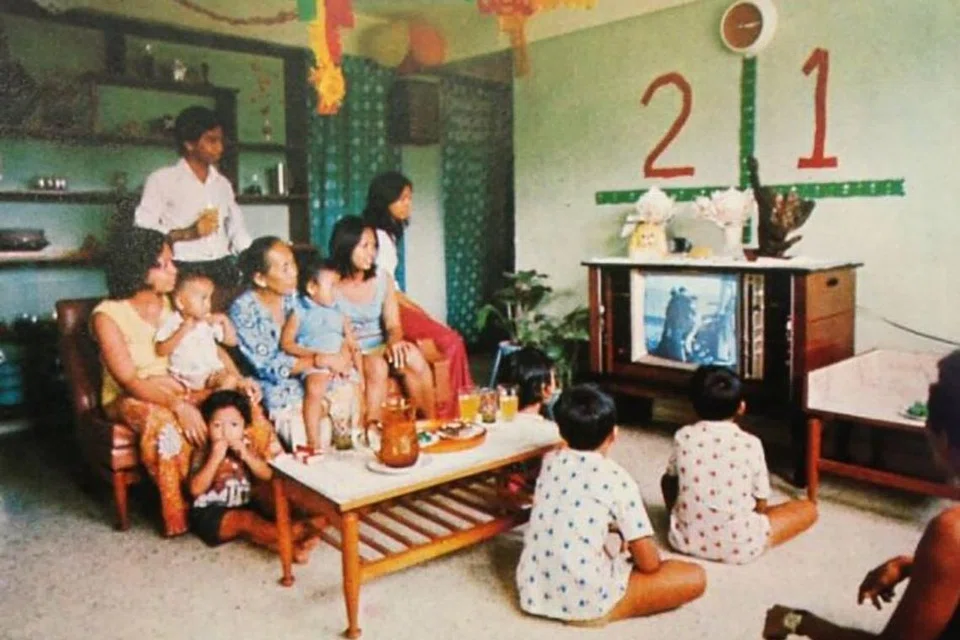
Imagine me – at 10 years old – watching television at a neighbour’s house with about half a dozen other children.
When TV first appeared in 1963, only the well-heeled could afford it. Many families were not so fortunate.
Although in black and white then, TV was already a game changer by bringing scenes of significant events into living rooms.
For instance, on Aug 9, 1965, Mr Lee Kuan Yew, the founding Prime Minister of Singapore, cried during a televised press conference after Singapore’s separation from Malaysia.
Television had captured a poignant moment in Singapore’s history – an eternal visual reminder of a leader’s concerns about the survival of his tiny nation venturing alone into the future.
Soon after, we too had a TV at home and faithfully watched locally produced Malay “sandiwara” dramas, Hindi and Tamil movies and Western programmes.
As my father was rather conservative, we children would look away whenever there was a kissing scene. Shootings, stabbings and other violent behaviour were okay.
One programme the family would make sure never to miss was the inter-school English-language debates. It ran from 1969 to 1991 and featured participants who went on to become major public figures. These included politicians Vivian Balakrishnan and Ho Peng Kee and legal eagles Walter Woon and Edmond Pereira.
Colour TV sets appeared in May 1974 but my parents saw it as an unnecessary expense.
Our neighbours thought otherwise, especially after it was announced that Singapore would broadcast the World Cup final live, in colour, on July 7 that year.
I remember watching the game at home in black and white. I was 21 years old and too embarrassed to head over to my neighbour’s house to watch Holland v West Germany in colour.
Due to budgetary constraints, Radio & Television Singapore, or RTS – Singapore’s first TV station – often repeated programmes and aired reruns of old sitcom episodes, so many of us dubbed it “Repeat Television Station”.
We were convinced it was why RTS was later renamed the Singapore Broadcasting Corporation. Today, it is called MediaCorp.
In the 1990s, my family members would gather in front of the TV set and watch shows such as Under One Roof, Growing Up and Phua Chu Kang.
Today, everyone is viewing their favourite content – whether it be on YouTube, Netflix or social media platforms – on their own personal device.
In most homes, the TV is for only grandpa and grandma. How times have changed.
By Khush Randhawa