As a teenager growing up in India, Durga Puja was a time I always looked forward to.
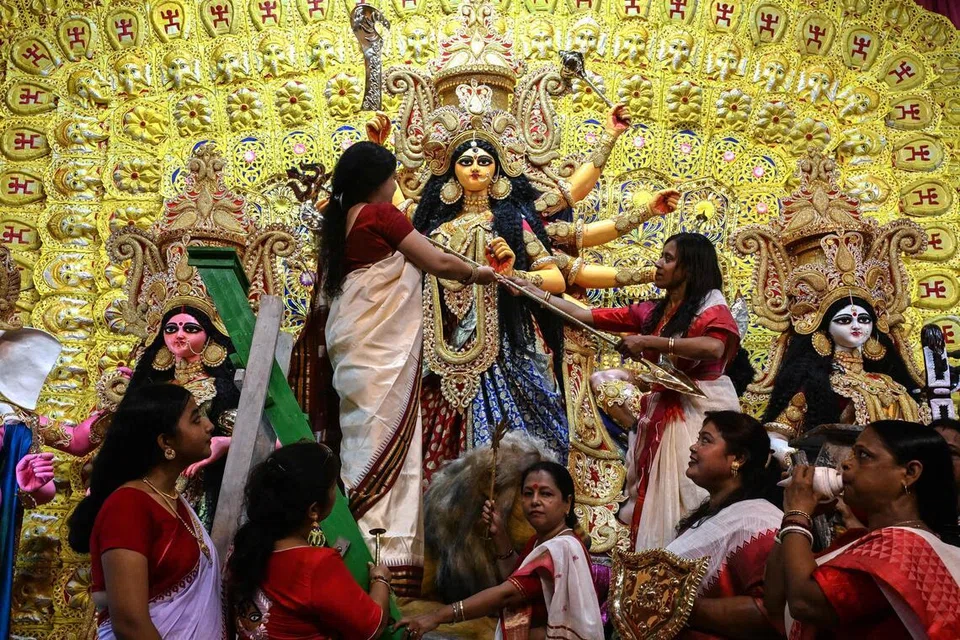
For starters, it meant going around puja pandals (temporary tents housing images of the goddess Durga) for five days every year.
One morning during the five-day Pujas, I would join a group of devotees, freshly bathed, in new clothes, offering “pushpanjali” (prayers said with flowers), echoing the words chanted by a priest in front of the deity.
Inevitably, my eyes would fasten on the face of the goddess and how beautiful she looked. As a Bengali, how could I not love Ma Durga?
Durga Puja is the biggest Bengali festival, celebrated as public holidays in Kolkata and the rest of West Bengal during the month of October.
I haven’t missed the festivity in all my years living and working in Singapore, offering “pushpanjali” whenever the occasion comes around. I would simply head to the Ramakrishna Mission on Bartley Road to offer my prayers. Here, it
Durga Puja at the Mission is a moving experience, marked by spiritual fervour, uplifting hymns and the veneration inspired by the swamis. After prayers in front of a revered glass-framed picture of Ma Durga, my wife and I would yearn to see sculpted images of the goddess – for that is how Durga Puja is typically celebrated, by worshipping clay images of the deity.
Fortunately, these can be found in Singapore. Pujas are being held this year at Farrer Park, Arya Samaj opposite Mustafa Centre in Little India, the Singapore Sindhi Association in Mountbatten Road, Chinese Garden, Pasir Ris and Jurong East, according to Facebook posts.
It’s such a change from the early 1990s when I was new to Singapore. My early memories include Bengalis celebrating Durga Puja at the Indian Association in Balestier, where housewives cooked food for devotees.
I remember watching the puja organised by the Bengali Association Singapore, held in an elaborate pandal near Farrer Park Hospital. Members of the association would enter the pandal for worship, while others could watch from a cordoned-off area.
Pujas organised by Bangladeshis here allow everyone to enter the pandals, offer prayers and eat “bhog” (a vegetarian meal offered to the gods).
Mr Uttom Kumar Nag, president of Bengali Community (Singapore), says one reason they started their own pujas was to avoid any discrimination. They have spent about $70,000 on Durga Puja at Chinese Gardens, importing the image of the goddess from Kolkata.
Mr Chandranath Bhattacharya, a sitarist, officiates as a priest at the Durga Puja organised by the Bangla Universal Society, which moved from Beatty Road to Upper Dickson Road this year. He has been performing puja in Singapore since 2011.
The puja timings differ every year, depending on the almanac, requiring priests and devotees to go without food till they have completed their prayers. Sometimes that means fasting till night, but Mr Bhattacharya is happy to fast, worship the goddess and recite the prayers that others chant with him.
My wife and I were in Kolkata during Durga Puja in 2022 and were dazzled by the spectacle. The city at night was like a mini Las Vegas – the lights, the artistry and ingenuity of the decorations, and the pandals built to resemble famous landmarks or episodes from mythology. Fantasy transformed dusty, congested Kolkata into a lavish theme park.
The festival ended with a street parade as the idols were ferried in beautifully decorated floats, accompanied by dancers, for immersion in the Ganges River. The idols were slid overboard from boats and sank without a trace. It was a gorgeous finale to Durga Puja in Kolkata, a joyous and colourful festival that has a place on Unesco’s Intangible Cultural Heritage India List.
I have seen the idols transformed by the potters’ magic. They begin life as bamboo skeletons, which are then “fleshed out” with clay. Thus, they are left to dry in the sun as headless torsos in potters’ colonies in Kolkata. The faces are moulded separately.
A significant moment is reached when the potters paint Durga’s eyes. This is when the idol is said to “come to life”. The eyes are drawn to mesmerise. Anyone looking at the goddess will pause at her large, soulful eyes.
The image of the deity during Durga Puja is fascinating: She is standing astride a lion, driving a spear into the heart of a demon partly disguised as a bullock, yet her face looks so serene.