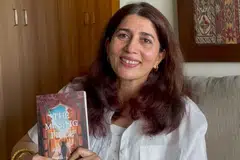

What the Tongue Remembers – Anitha Devi Pillai’s eleventh book and her first collection of short stories, captures food as a conduit – a character of its own, tacitly existing between every other character conjured up in this 300-page read.
Inspired by the Malayalee community, to which Dr Anitha belongs, the stories largely explore the colourful lives of Malayalee women at distinct points of their lives.
An academic who studied the Singapore Malayalee community as an applied linguist, with an anthropological interest in language, migration and cultural practices, Dr Anitha shared that she attempted to move away from the singular definition of ‘diaspora’ as leaving one country and longing for another.
Instead, she wanted to capture what identity looks like once people have lived somewhere for a substantial period of time. Her characters therefore range from those deeply attached to Kerala to those with little connection to it at all, from fluent Malayalam speakers to those who barely speak it and inhabit their identity differently.
This question of identity also manifests in the dialogue about food, which she then investigates in her narratives.
In one of the eleven short stories, a Singaporean Malayalee woman discovers that the Kerala food her husband considers ‘authentic’ is not exactly what she grew up relishing, as recipes evolve when food travels across regions.
“That tiny domestic disagreement contains a much larger question: Who gets to decide what is authentic?” Dr Anitha said.
“Food runs through all eleven stories, but almost like another language. What someone cooks, refuses to cook, remembers eating, or feeds another person can reveal things they might never say aloud,” she said.
Over the five years of her fieldwork, Dr Anitha noted that food often helps her break down barriers and establish a connection with the person sitting across her – a dish would invite a memory and prompt reminiscing.
Hence, she asked eleven women to share a family recipe and included them in her the book, alongside detailed memories tethered to them.
Despite being thematically concerned with women and food, Dr Anitha clarified that the book is layered.
“It is also about the lives we build around relationships and what happens when those relationships don’t quite turn out as we imagined,” she told tabla!.
And the book reads exactly like that. There is a warmth in how Dr Anitha approaches these complex characters that wills a reader to be drawn to their cause. Whether you are part of the Malayalee community or not, the stories resonate as she captures a certain universality in the humanity of her characters.
The book launch
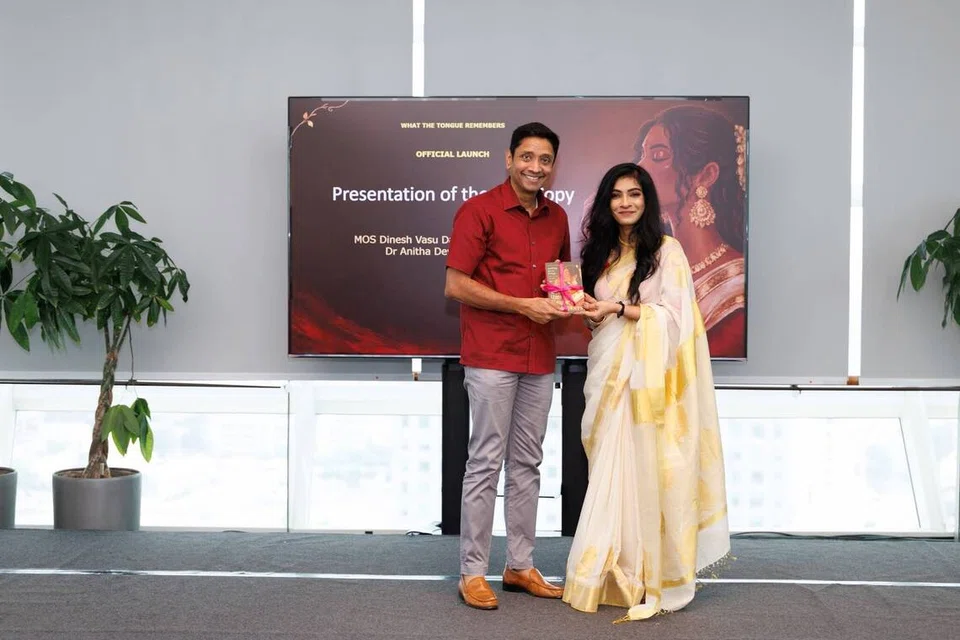
What the Tongue Remembers was launched on Sept 20 at a ceremony hosted by the National Library Board.
Guest of honour, Ministry of Culture, Community and Youth and Ministry of Manpower Dinesh Vasu Dash was joined by Paul Thoppil, Canada’s ambassador to Singapore, alongside colleagues, students and members of the Singapore Malayalee community who had varying extents of influence in the creation of What the Tongue Remembers.
At the launch, Dr Anitha traced the foundations of the book to her master’s thesis, when her supervisor pushed her to continue exploring her narratives upon completion of her thesis.
After thanking the colleagues in academia who were in her corner, she shared her hope the book would make a small but meaningful contribution to Singaporean Literature, carrying stories embedded in one of Singapore’s smaller communities into the wider literary landscape.
She also reserved gratitude for the Singapore Malayalee community, who over the years “opened their homes, shared their memories, supported my work, with extraordinary generosity.”