
With hundreds of handcrafted dolls, six months of preparation and an entire floor devoted to storytelling, Mrs Sujatha Krishnan’s Navaratri display has become a remarkable celebration of Indian heritage in Singapore.
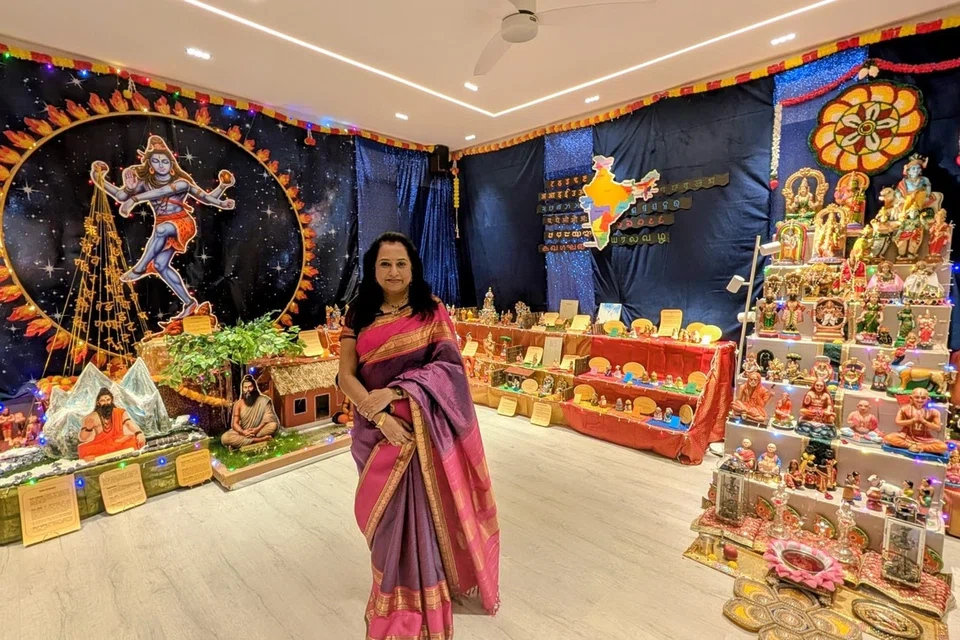
Every Navaratri, an entire floor of a three-storey house in Jalan Puteri Jula Juli undergoes an extraordinary transformation.
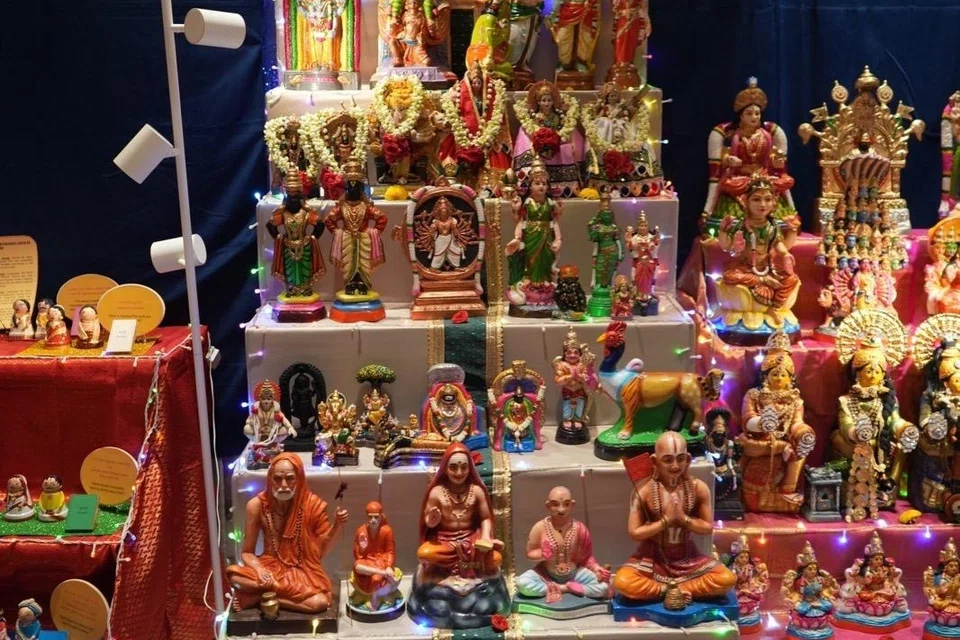
Hundreds of dolls, miniature landscapes, mythological figures and elaborate settings come together to create one of Singapore’s most impressive Golu displays.
Behind this painstaking annual undertaking is Mrs Sujatha Krishnan, whose passion for preserving Indian traditions has turned a family celebration into a cultural attraction.
This year’s theme, Shruti to Shabda – from the sounds the rishis heard to the authoritative spoken and written word – explored the origins, evolution and significance of Indian languages within Hindu philosophy and civilisation.
For Mrs Sujatha, a Sanskrit student, the subject was particularly meaningful.
“I see firsthand the incredible beauty and structure of our ancient languages,” she said. “They are not dead relics of the past. They are living, sacred systems of philosophy and love that have survived for thousands of years.”
Visitors entered through a starry corridor depicting the birth of sound and the four levels of speech.
At the centre stood an imposing Shiva Nataraja, with the 14 drumbeats associated with the Maheshvara Sutras flowing towards the ancient Sanskrit grammarian Panini.
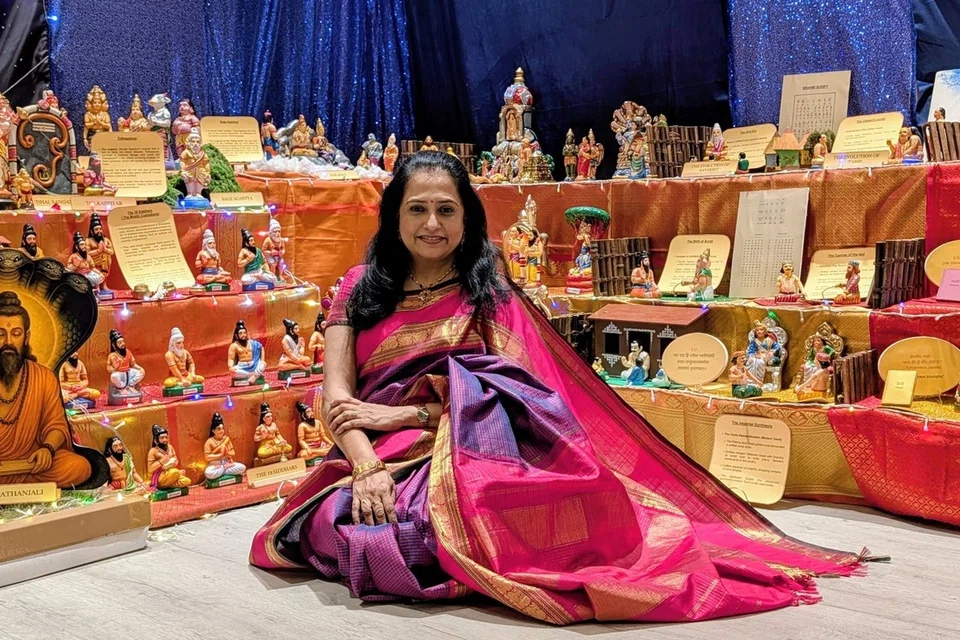
Another section celebrated Tamil heritage through Sage Agastyar, the Mudhal Sangam, the 18 Siddhars and the Alwars.
A fascinating display traced the evolution of scripts, illustrating how oral traditions came to be recorded on palm leaves and how writing materials influenced letterforms.
Senior corporate leader and arts board director Ranjani Rangan described the exhibition as an immersive journey through India’s linguistic heritage.
“What makes Sujatha Krishnan’s Golu so extraordinary is how she transforms a traditional display into an immersive walkthrough journey of the evolution of languages,” she said.
“A personal highlight is seeing how these spoken sounds were physically carved onto palm leaves, creating the rounded curves of ancient manuscripts.”
She particularly appreciated how the display connected Sanskrit and Tamil traditions with the evolution of written scripts.
The traditional Golu steps featured representations of Shakti, while a miniature marketplace and a numerical display representing numbers one to 10 added further variety.
Mrs Sujatha remarkably creates almost all the dolls herself.
This year, she crafted more than 20 new figurines using homemade clay, plant pots, Styrofoam balls and recycled materials.
The Nataraja figure and the trio of Panini, Vararuchi and Patanjali were constructed using foam and cardboard.
Nataraja’s ring of fire featured individually fashioned glitter-foam flames attached to a metal frame.
Mountains, trees and huts emerged from discarded cardboard, paper and tissue holders.
“The most time-consuming pieces were the couple dolls – painstakingly carving the hair and painting them,” Mrs Sujatha recalled.
Preparations begin six months before Navaratri, involving extensive research, theme development, scriptwriting and planning.
The actual construction takes another six to eight weeks, with her family helping with heavy structures, drapery and audio arrangements.
Dr Poornima Kumar, a London-based consultant haematologist, was particularly impressed by the craftsmanship.
Visiting Singapore during Navaratri after nearly 30 years away from the local Golu circuit, she described Mrs Sujatha’s display as “astoundingly creative and visually evocative”.
“The creation of Sanskrit was beautifully explained, akin to a live action Amar Chitra Katha,” she said.
She was especially astonished to discover that Mrs Sujatha had fashioned dolls representing Indian languages from miniature plant pots, painstakingly painting and dressing them.
“I feel blessed to have been invited to be part of this spectacular,” Dr Poornima said.
A former human resources professional who left corporate life to care for her family, Mrs Sujatha also volunteers with Mountbatten Community Club.
Her fascination with Golu began in 2008, when she arranged a modest three-step display to introduce her children to Indian traditions.
“While I originally wanted my children to know about our heritage, I ended up finding out much more about the traditions myself,” she said.
That discovery inspired increasingly ambitious displays.
This year’s Golu attracted nearly 200 visitors, including neighbours, Indian families and people from other cultural communities.
Homemaker Archana Deepak, a regular visitor, said Mrs Sujatha’s creativity continued to surprise her.
“Exceptional is the one word that always comes to mind when I visit Sujatha’s Golu!” she said.
“What I love most is how Sujatha transforms her Golu into a beautiful journey of learning, devotion and discovery.”
She added that the family’s warm hospitality made every visit memorable.
Retired civil servant Su Boo Hui Felix was equally impressed, particularly by the miniature marketplace.
“Awesome display of the Golu, which was both grand and exuding vibrancy!” he said.
“The village marketplace display was brilliant, capturing its essence with her intricately hand-painted dolls, stalls and merchandise.”
Children particularly enjoyed the saree shops, traditional household appliances and a grandmother serving pongal and vadai.
Simple explanatory cards helped visitors understand the stories behind the exhibits.
Some visitors were deeply moved by the experience. Two prostrated before the display, while another subsequently researched Panini and expressed an interest in learning Sanskrit.
For Mrs Sujatha, such reactions justify the exhausting effort.
“The moment the festival starts, the incense is lit, and the first guest walks in, all my tiredness disappears,” she said.
“This is my offering of devotion – bhakti – and my tapasya too.”
In multicultural Singapore, her Golu has become more than a religious observance. It is a living classroom preserving language, craftsmanship, mythology and cultural memory for younger generations.
“Through my humble efforts, I hope to preserve these stories for the next generation,” she said. “Art, knowledge and tradition – that’s what my Golu stands for.”
Despite the physical demands, she has no intention of scaling down.
She hopes to continue for as long as she is able, ensuring that India’s ancient stories remain alive in Singapore.