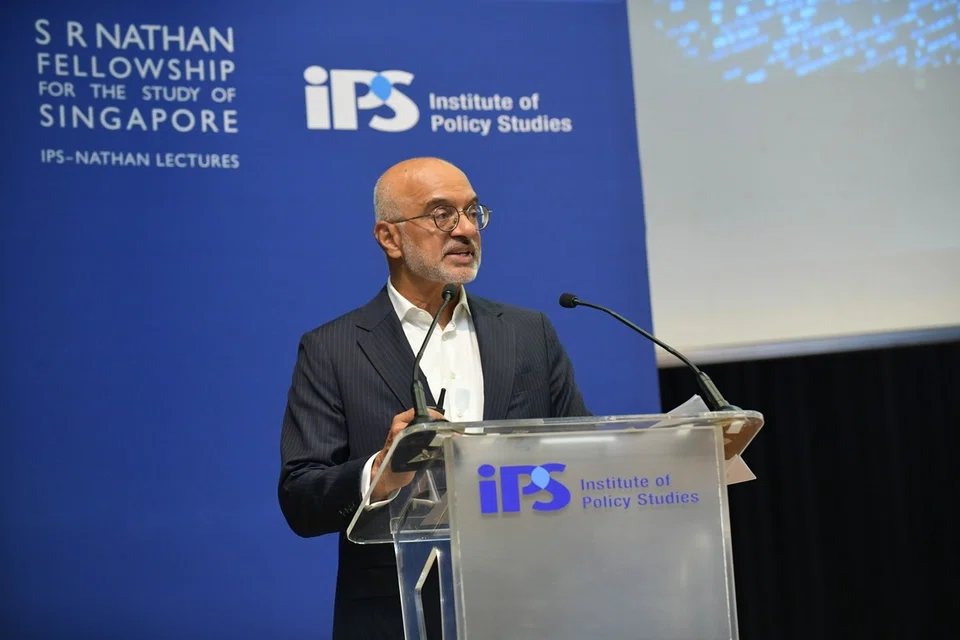

Singapore transformed itself from a largely cash-based economy into one of the world’s most advanced digital financial hubs in less than a decade – this achievement required a mix of policy foresight, public-private collaboration, and a deliberate effort to keep innovation and trust in balance, highlighted former DBS chief executive Piyush Gupta.
A decade ago, cash ruled Singapore’s financial landscape. Today, a smartphone and a QR code have replaced the wallet. This transformation didn’t happen by chance. It was propelled by a deliberate national strategy to make Singapore a “Smart Financial Centre”, blending technological innovation with regulatory foresight, Mr Gupta said.
Speaking at the 17th IPS-Nathan Lecture Series on Nov 3, held at the National University of Singapore (NUS) and organised by the Institute of Policy Studies’ (IPS), Mr Gupta noted that between 2015 and 2024, the value of Fast and Secure Transfers (FAST) payments surged almost eighteenfold, from S$37 billion to S$664 billion, while cheque payments fell by about half and ATM withdrawals by 16 per cent.
Additionally, over 90 per cent of Singaporeans aged 20 to 75 now use PayNow, and a similar percentage of merchants accept SGQR, the unified national QR standard.
The Monetary Authority of Singapore (MAS) took a “proactive stance”, launching the FinTech and Innovation Group in 2015, setting up a regulatory sandbox for controlled experimentation, and creating the Singapore FinTech Festival, now considered the world’s largest FinTech event, Mr Gupta pointed out.
Infrastructure also played a decisive role. The FAST interbank system, introduced in 2014, enabled real-time 24/7 transfers, years before the US or Europe caught up, he said.
PayNow followed in 2017, linking mobile numbers and ID cards directly to bank accounts. Cross-border payment linkages now connect Singapore to Malaysia, Thailand, Indonesia, and India. The result is a financial ecosystem that is faster, more connected, and increasingly inclusive, where even traditional banks have evolved to survive, Mr Gupta said.
Citing his own experience in DBS bank, he recalled: “We were one of the first banks in the world to embark on a transformation journey, crafting a program called ‘Making Banking Joyful’.” Its success mirrored Singapore’s own digital journey, which has been bold and intentional, he added.
Yet this new digital order brings fresh risks. As payments go cashless, financial exclusion looms for seniors and those less tech-savvy. Regulators have responded with calibrated targets, digital literacy drives, and initiatives like IMDA’s ‘Seniors Go Digital’, which equips senior citizens with the knowledge and skills to embrace digital technology.
“I spent many a Saturday morning at hawker stalls, sitting with elderly people, trying to show them how they could use PayLah! simply on their mobile phones.”
These initiatives, Mr Gupta noted, have paid off as it helped raise senior participation in online payments from 38 per cent in 2018 to 78 per cent in 2022.
At the same time, cybercrime and scams have soared. “Financial institutions face heightened liquidity risks associated with digital banking and higher incidents of cybercrime,” Mr Gupta said.
Reported scam cases rose 11 per cent last year, with total losses exceeding S$1 billion. Digital convenience also enables fraud at unprecedented scale and speed. When it comes to scams, questions of accountability – whether losses should be borne by individuals, banks, telcos, or platforms – remain unresolved.
As Mr Gupta noted, “In dealing with scams where scammers are the clear villains, the parties accountable for losses are often unclear.”
The challenge lies, he said, in preventing moral hazard – ensuring that neither consumers nor institutions become complacent when others bear the cost of mistakes.
“If losses are fully borne by institutions such as banks and telcos, then individuals may lose the incentive to remain vigilant or may result in a situation where scammers pose as victims.” On the other hand, if individuals bear full responsibility, then institutions may lose their standards for safeguarding consumers, he noted.
Singapore’s answer, as always, is balance. Regulators are striving to preserve innovation without compromising trust, maintaining stability while enabling competition. Reciprocity in data-sharing is one such principle.
“If you draw data, you must also contribute data,” Mr Gupta said. The goal is a level playing field, where both incumbents and new entrants thrive, and where technology serves society rather than disrupts it.
Ultimately, Singapore’s digital finance story involves constant calibration. As Mr Gupta observed, it took vision, coordination, and trust among regulators, banks, and tech players to make this transformation possible.