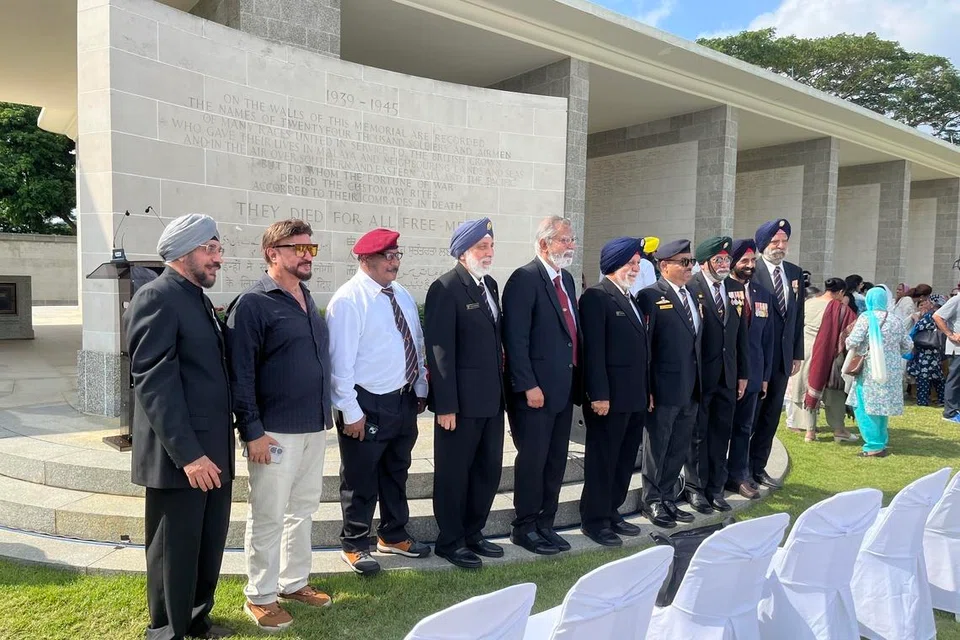

Like a solemn sentinel, the Singapore Memorial stands at the highest point of the Kranji War Cemetery as a stately tribute to the fallen of the Second World War (WWII). Its 12 stone-clad columns bear the inscribed names of over 24,000 personnel with no known graves.
These inscriptions include 3,318 fallen soldiers with the name “Singh”, drawn from communities from across the undivided Punjab, including 559 soldiers from the Doab region, who gave their lives defending British Malaya and Singapore.
To honour the Sikh and Punjabi soldiers who fought in WWII, the Pardesi Khalsa Dharmak Diwan (PKDD), one of the oldest Sikh institutions in Singapore that was founded in 1926, held a memorial ceremony on Feb 8 as part of its centennial anniversary.
“Many would have been our forefathers’ neighbours or relatives. They would have been men from the same villages or towns, who left home together and followed one another into service,” said PKDD president Navin Pal Singh.
He explained how these soldiers fought under foreign skies, asking for little in return, except the hope that the future generations might live in peace.
Mr Navin Pal also added that remembrance itself is a moral responsibility, which unites everyone.
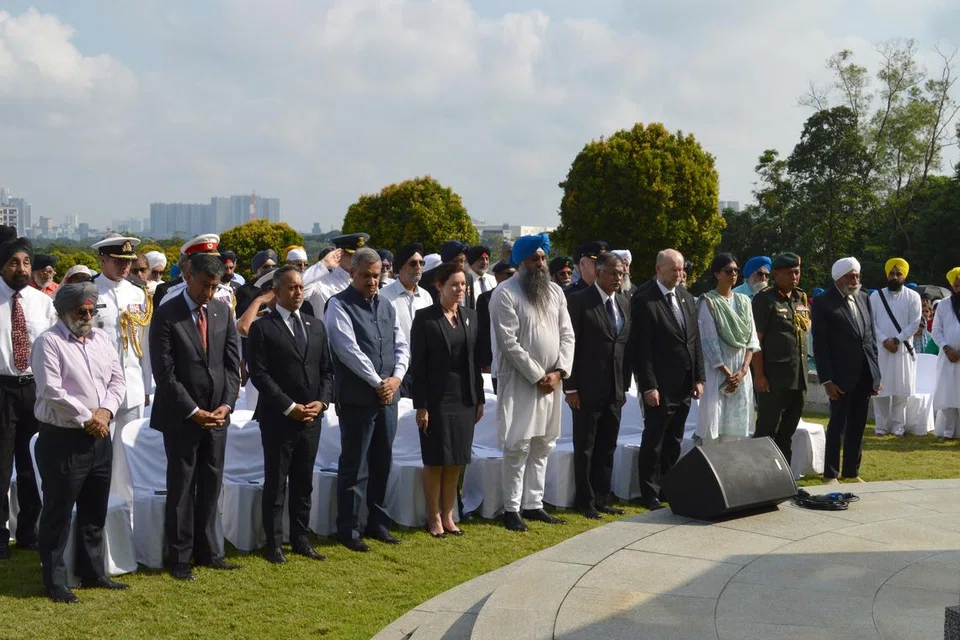
The ceremony drew about 350 attendees, comprising Sikh veterans, local community members, and foreign dignitaries, such as the High Commissioners to Singapore from the United Kingdom, Canada, Australia, New Zealand, India, and Pakistan. Colonel Rosidi Mat Saad represented the High Commission of Malaysia.
“Grief does not recognise nationality. Sacrifice does not belong to one people. And peace, when achieved, belongs to all,” Mr Navin Pal said.
Senior Minister of State (SMS) for Law and Transport Murali Pillai also graced the event.
In his speech, he highlighted the contributions of Sikh soldiers during WWII, who served in the Singapore Volunteer Corps, Straits Settlements Police Force, Sikh Pioneer Corps, and British Indian Army regiments.
“Their graves and names on these walls teach us that peace is hard won,” SMS Murali noted.
He also cited several notable Sikhs who played instrumental roles in Singapore’s defence and security. An example included Major-General Ravinder Singh, Singapore’s Chief of Army from 2011 to 2014, and the first Sikh to hold this distinguished appointment.
“These individuals represent only a fraction of the Sikh men and women who have served with commitment and excellence, both within the uniformed services and across all sectors of society,” SMS Murali added.
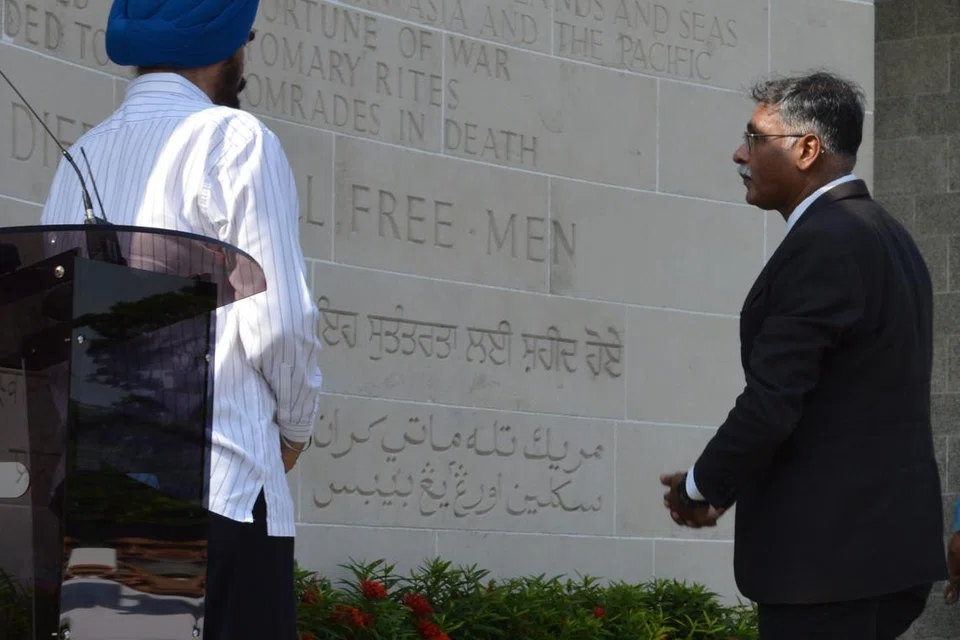
He then laid a wreath under the inscription “They Died For All Free Men”, followed by the respective diplomatic heads to form a symbolic row of unity and remembrance in honour of the fallen WWII soldiers.
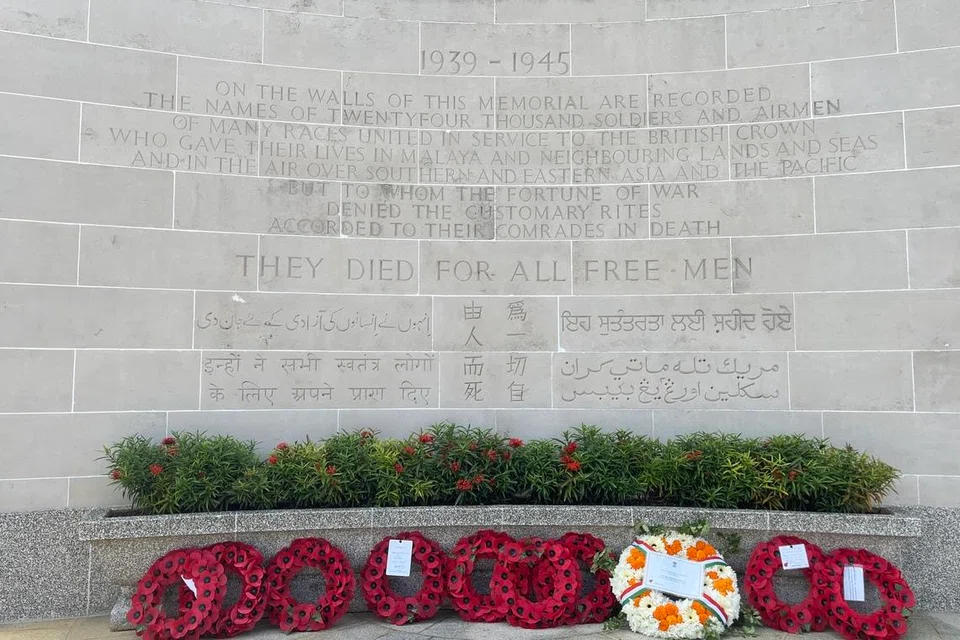
In a show of respect, all the guests stood up and observed one minute of silence.
This was followed by a recital of kirtans and ardas, Sikh hymns and prayers, which were led by the PKDD priests at the Singapore Memorial.
A young Sikh was then invited onto the podium to share her reflections on the remembrance service with the entire congregation.
“I belong to a generation that inherited peace as normal. We grew up assuming progress was automatic, that rights would expand and that the world would keep getting safer. But then we watched how quickly that assumption can unravel,” Ms Jasmir Kaur said.
The 30-year-old graduate from the University of Edinburgh opined that remembrance must leave us with more than just emotion – it must leave us with wisdom, the kind that translates memory into action.
As a representative of the SAF Veterans’ League, retired Colonel Gurcharan Singh had also laid a wreath during the memorial ceremony. He noted that remembrance is essential for the simple reason that we do not forget those who sacrificed their lives to secure our future.
“Otherwise, we may not be around. I was born during the Second World War, and I was just a kid. Still, I am grateful to them because they fought for me,” Mr Gurcharan poignantly said.