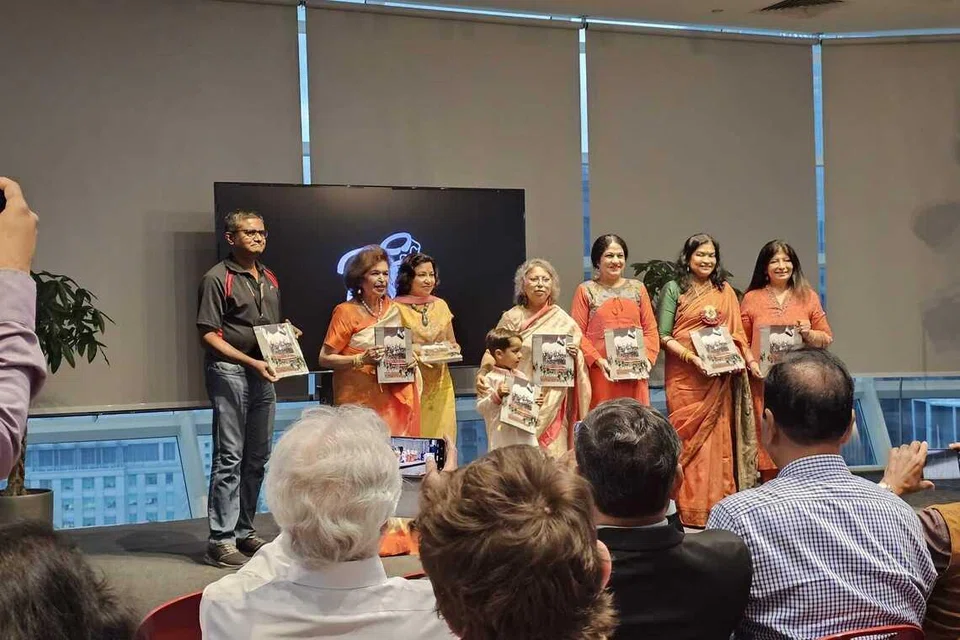

History, cinema, and patriotism converged in a stirring literary evening as Tagore Society Singapore launched Kadam Kadam – The Long March at the National Library Building on Jan 28, marking Singapore’s 60th anniversary and India’s 77th Republic Day.
The novel, penned by legendary Bengali writer and screenwriter Nabendu Ghosh and posthumously translated by his daughter Ratnottama Sengupta, captures the extraordinary wartime transformation of Indian film actor Nazir Hussain – whose life took a dramatic turn in Singapore during World War II.
Nazir, best known for his roles in post-independence Indian cinema, had once walked the very streets of Singapore – not as a performer but as a soldier of the Indian National Army (INA), inspired by Netaji Subhas Chandra Bose.
His real-life journey from a British Indian Army recruit to a loyal INA fighter is at the heart of The Long March, offering an emotional retelling of how one man’s conscience and conviction redefined his destiny.
“This is more than just a novel – it’s a bridge between forgotten history and the modern reader,” said Ms Ratnottama, who attended the launch and spoke of the translation process as a personal and revelatory journey.
“I had vague knowledge of Indians joining the British Army or fighting in Southeast Asia. Translating this book uncovered layers of history rarely acknowledged – how Singapore became a theatre of transformation for people like Nazir Hussain.”
The evening’s emotional peak came with a live choral rendition of the INA anthem Shubh Sukh Chain by Pranay Ghosh, Paromita Chakraborty, Trupti Panda, Priyajit Ghosh, and Abhijit Mukherjee.
Originally adapted from Rabindranath Tagore’s Bharoto Bhagyo Bidhata and set to a rousing martial score by Captain Ram Singh Thakuri, the anthem was the official song of the Azad Hind government and was first played on Indian Independence Day in 1947 at the Red Fort in New Delhi.
“Hearing the INA anthem performed live in Singapore, where it was born, was electrifying,” said an attendee. “It felt like 1943 had stepped into the present.”
The Long March stands as Nabendu’s literary farewell and a tribute to both the cultural resilience of Indians abroad and the shared struggle for freedom.