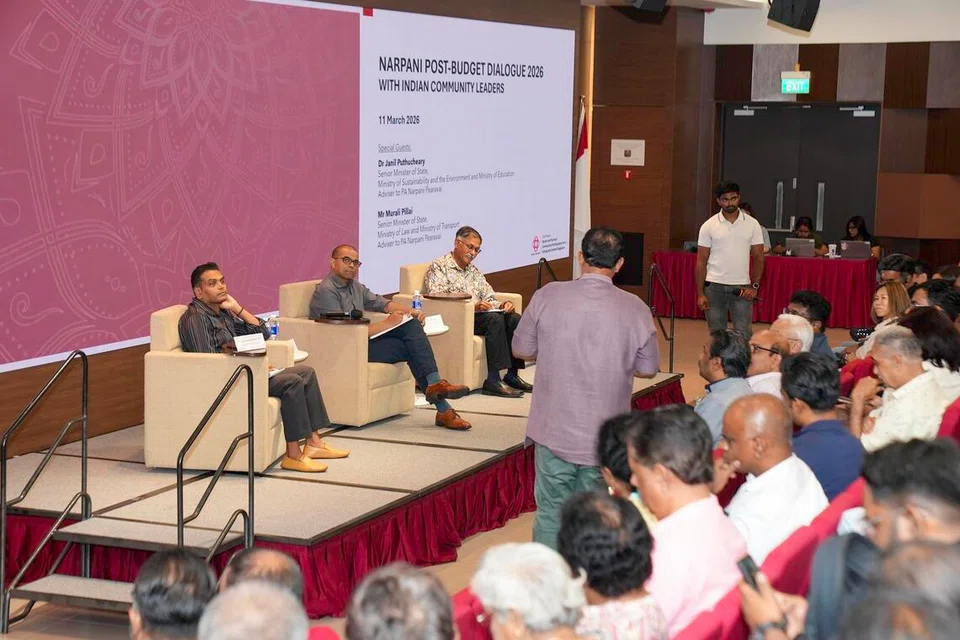

The rapid advancement of Artificial Intelligence (AI), how it could disrupt traditional roles like accounting, and the necessity of developing localised AI models trained in Tamil, took centre stage at the post-Budget dialogue organised by the People’s Association Indian Activity Executive Committees Council, also known as Narpani Pearavai, on March 11.
Economic and business anxieties were also raised, particularly the Food and Beverage sector’s struggles with high rental costs and foreign manpower quotas.
Opening the session, Senior Minister of State for Sustainability and the Environment and Education, Dr Janil Puthucheary, said such dialogues are important opportunities to tackle pressing issues.
“Some events are celebratory, where we enjoy the food, the fellowship, and the sense of community,” he said. “But we also need occasions like this to discuss hard issues, challenging issues, and get down to the nitty-gritty details,” he noted.
Held annually for nearly two decades, Narpani’s dialogue session provides a platform for Indian community leaders and volunteers to discuss policy directions outlined in the national Budget and raise ground concerns directly with policymakers.
Senior Minister of State for Law and Transport, Mr Murali Pillai, joined Dr Janil in chairing the dialogue, both of whom are advisers to Narpani Pearavai.
Thanking the grassroots volunteers for their continued service, Mr Murali highlighted a recent Narpani Pearavai survey, which found that more than 90 per cent of Indian Activity Executive Committees (IAEC) were willing to take on a greater role in linking families with support services.
“Traditionally, we focused a lot on cultural activities,” Mr Murali said. “But today we have evolved. One important area is really about keeping an eye out for families who may have needs and making sure they are connected to the right help.”
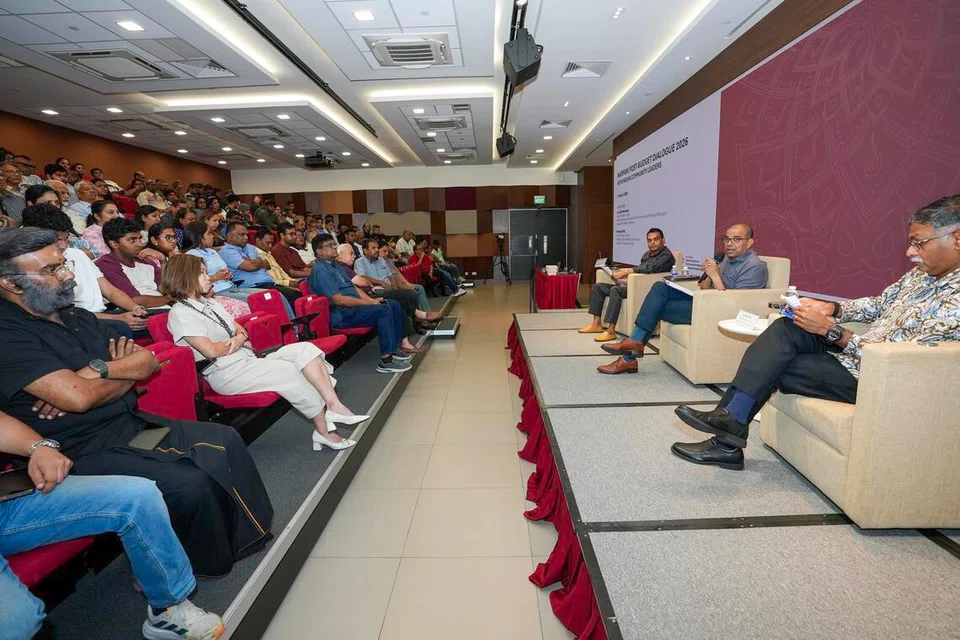
Meanwhile, Dr Janil cited a recent collaboration in Punggol, where Narpani volunteers and the self-help group Singapore Indian Development Association (SINDA) conducted a joint door-knocking exercise to connect vulnerable Indian families with assistance programmes.
Self-reliance in an uncertain world
Dr Janil placed the discussion in the context of a weakening rules-based global order, noting that Singapore has repeatedly navigated major external shocks.
Reflecting on the unpredictable global climate in his closing remarks, Mr Murali cited the recent return of Singaporeans on a Republic of Singapore Air Force (RSAF) flight, necessitated by the cessation of commercial airline operations. “This exemplifies the uncertain world we are living in,” he said. “The point is that we have to depend on ourselves to deal with this kind of uncertainty.”
“Singapore has to get it right all the time. That is the burden we carry as community leaders and as a government. We adapt, but we don’t fray. We don’t break as a society,” he added.
Speaking to tabla! at the sidelines of the event, Narpani Pearavai chairman Ganasen emphasised that while indicators such as graduate numbers and top earners among Indians have improved, a segment of the community still needs targeted help.
Initiatives like the newly introduced Indian Engagement and Development Initiative (INEI) committee are meant to uplift them, Mr Ravindren noted.
He said that the feedback gathered from this session will be collated, analysed, and presented to relevant government agencies to help inform future policy decisions.
One of the participants, accountancy student Faheemah S.A. Rashiq, 20, from Jalan Besar Indian Activity Executive Committees, asked about financial assistance for students pursuing tertiary education.
“Up to junior college, there are clearer schemes like the Financial Assistance Scheme,” she said. “But after that, it can feel less straightforward. It would help if students had a clearer awareness of where they can seek help.”
She said Dr Janil acknowledged that the issue was complex but assured participants that it remained under review. “It was encouraging to hear that it is something the Government is constantly looking at,” she said.
Another participant, 22-year-old psychology student Sandhya Karthigeyan from the Jurong Green IAEC, said that she raised the issue of mental health stigma in the Indian community and expressed concerns about AI replacing human counsellors.
“In our community, talking about mental health or seeking help can still be taboo,” she said. “It was good that the advisers listened carefully, took notes and responded directly to the questions raised. It felt like our concerns were being taken seriously.”