
Against a backdrop of geopolitical tensions, energy insecurity, and a fragmenting global economy, policymakers, academics, and industry leaders gathered at the second India-Singapore Futures Forum to chart a path for deeper bilateral cooperation in sustainability, energy transition, and emerging technologies.
Held by the Institute of South Asian Studies at the National University of Singapore, the forum centred on the theme “Accelerating Green Transitions: India-Singapore Cooperation in a Fragmenting World Economy”.
Opening the session, Associate Professor Iqbal Singh Sevea said the event came at “a moment of significant global change”.
“The energy and climate landscape is being reshaped by geopolitical tensions, supply chain disruptions, and technological shifts,” he said, warning that developments in the Middle East had underscored “how quickly geopolitical shifts can affect energy security and economic stability”.
The forum built on a year of intensified bilateral engagement between Singapore and India, including the third India-Singapore Ministerial Roundtable in 2025 and reciprocal visits by senior political leaders from both countries.
India’s High Commissioner to Singapore, Shilpak Ambule, highlighted the growing strategic breadth of the bilateral relationship, noting that both countries had agreed on “a roadmap for a comprehensive strategic partnership”.
“The roadmap identified eight pillars to forge the future path of our partnership,” Mr Ambule added, referring to areas including digitalisation, sustainability, healthcare, semiconductors, artificial intelligence, nuclear energy and space cooperation.
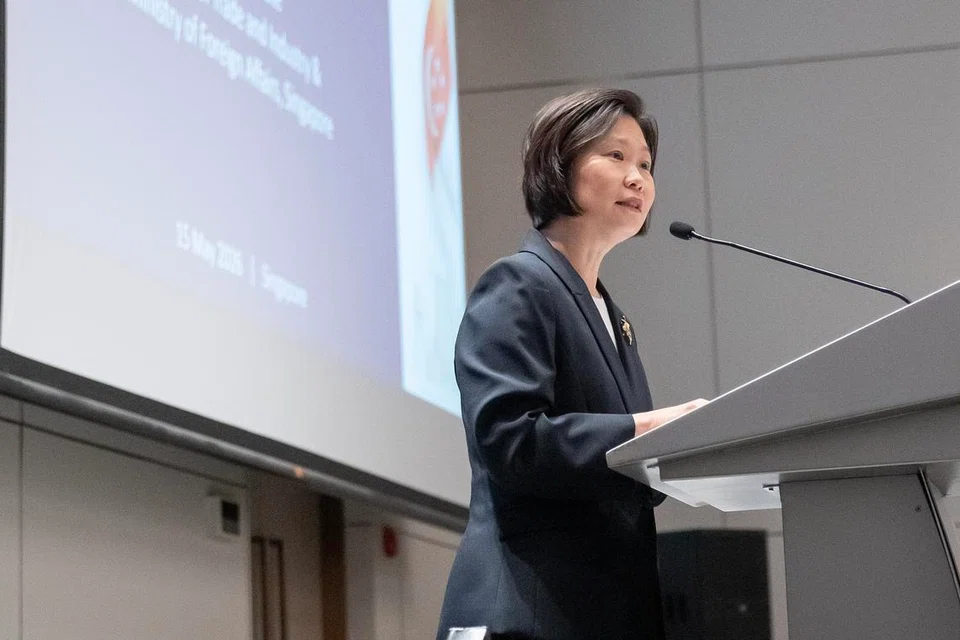
Singapore’s Minister of State for Foreign Affairs and Minister of State for Trade and Industry Gan Siow Huang framed the energy transition as one of the defining challenges facing governments worldwide.
“Around the world, governments are grappling with the same fundamental challenge – how to accelerate the transition towards low-carbon energy systems while balancing sustainability, energy security and affordability,” she said, adding that “this is what we call the energy trilemma and the trilemma is so real for Singapore.”
Ms Gan outlined Singapore’s “four switches” strategy for achieving net-zero emissions by 2050 while maintaining energy resilience.
The approach includes continued reliance on natural gas as a transitional fuel, expanded solar deployment, low-carbon electricity imports from neighbouring countries, and investments in emerging technologies such as hydrogen and small modular nuclear reactors.
“No single pathway will get us to net zero, which is why we have to look at a portfolio for us to be able to achieve affordable and sustainable energy, to have the energy security we need for the future,” she said.
Singapore has also launched an S$800 million Decarbonisation Grand Challenge to support research and catalyse private-sector investments in nascent green technologies.
Ms Gan pointed to a growing number of collaborative projects between Singapore and India, including a partnership between Nanyang Technological University, the Government of Odisha and the Indian Institute of Technology Bhubaneswar to pilot sustainable energy technologies.
She also cited the Singapore-India Green and Digital Shipping Corridor, witnessed by Prime Ministers Narendra Modi and Lawrence Wong in 2025, as a key initiative in maritime decarbonisation and supply-chain digitalisation.
“Partnerships enable us to share expertise, develop common standards and also to scale solutions that would be difficult to achieve in isolation,” Ms Gan said.
The forum repeatedly returned to the theme of complementary strengths between the two countries.
Assoc Prof Sevea noted that “Singapore’s strengths in finance, connectivity and innovation, complement India’s scale and capacity to deploy solutions.” This, he said, creates opportunities for cooperation in “clean fuels, low-carbon logistics, carbon markets, digital energy systems and sustainable industry.”
Mr Ambule echoed the sentiment, quoting remarks made separately by both countries’ leaders to underscore mutual confidence in the partnership.