
The goats were already assembled in the pre-dawn quiet, and the volunteers – 70 of them, ranging in age from 19 to 65 – had taken their positions along South Bridge Road before most of the city had stirred.
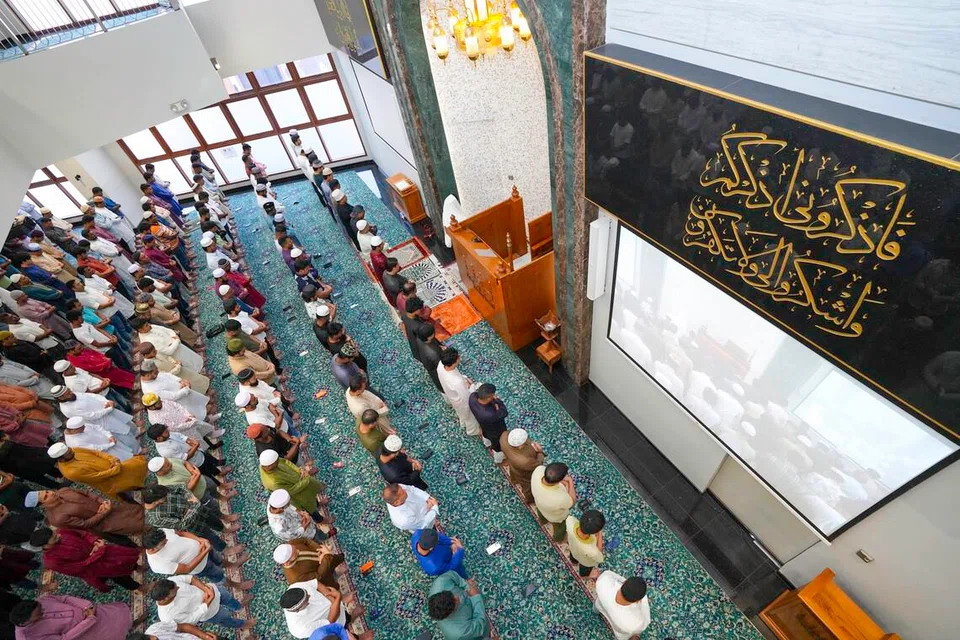
By the time the sun cleared the rooftops of Chinatown, Masjid Jamae Chulia, a green-plastered landmark that has stood on this corner since 1826, was deep into the rituals of Eid al-Adha, known here as Hari Raya Haji.
One hundred and thirty goats were slaughtered the morning of May 27 in partnership with Agromaster, a livestock dealer, in a ceremony that has been repeated in some form at this mosque for nearly two centuries.
Volunteers guided worshippers in witnessing the korban – the sacrifice at the heart of the occasion – and oversaw the distribution of meat to those in need. Elderly congregants were given dedicated assistance, ensuring that the ritual remained accessible regardless of age or mobility.
Eid al-Adha, one of the two most important celebrations in the Islamic calendar, commemorates the willingness of the Prophet Ibrahim to sacrifice his son in obedience to God.
Across Singapore’s mosques this year, the holiday unfolded as it always has – with early prayers, the slaughter of livestock, and the sharing of meat among family, neighbours, and the poor. But at several mosques, it also reached considerably further.
At Masjid Malabar, tucked into the historic enclave of Kampong Glam, approximately 1,500 worshippers attended Friday morning prayers across two sessions. The mosque did not conduct live korban on its own premises.
Instead, it arranged for overseas sacrifice through the SalamSG Korban programme, with sheep slaughtered in Australia on behalf of Singapore’s congregants – a practical accommodation that has become increasingly common as urban mosques navigate space and regulatory constraints.
What distinguished this year’s arrangement was where the meat was directed. MK Jameel, the mosque’s chairman, said that a portion had been set aside for humanitarian relief in Gaza, while the remainder would be distributed locally – to underprivileged families in the surrounding neighbourhood, to Bangladeshi Muslim migrant workers, and to Indonesian domestic helpers.
“The collective efforts of our congregation, volunteers, mosque staff and community partners helped foster a meaningful and well-organised Eid al-Adha celebration,” Mr Jameel said.
The distribution is scheduled for Sunday, with 50 to 60 volunteers expected to gather from 8 in the morning until noon to pack and hand-deliver the meat.
Across town, at Bencoolen Mosque, the celebration was more intimate. The morning began with the takbir, the communal declaration of God’s greatness at 7.30am. Nearly 800 worshippers eventually filled the prayer hall, including some 100 women.
The mosque does not sit at the heart of a residential neighbourhood, yet its congregation travels from across the city, drawn in part by something that is unique to Bencoolen Mosque – a Friday sermon delivered in Tamil. “Most of them come from all over Singapore to hear our Tamil sermon,” said Haji Mohamed Rafeeq, the mosque’s chairman.
“In our masjid, it’s mostly locals and their family members. There was a kind of kampung spirit,” he added, invoking the Malay word for village, and the warmth associated with a way of life that rapid urbanisation has largely displaced.
Every worshipper who attended, he noted, was welcomed with a cup of tea and a piece of rusk. “This Hari Raya Haji is very special for us,” he said. Taken together, the celebrations at Singapore’s mosques this year illustrated the range of forms that a single religious occasion can assume in a dense, pluralist city.